
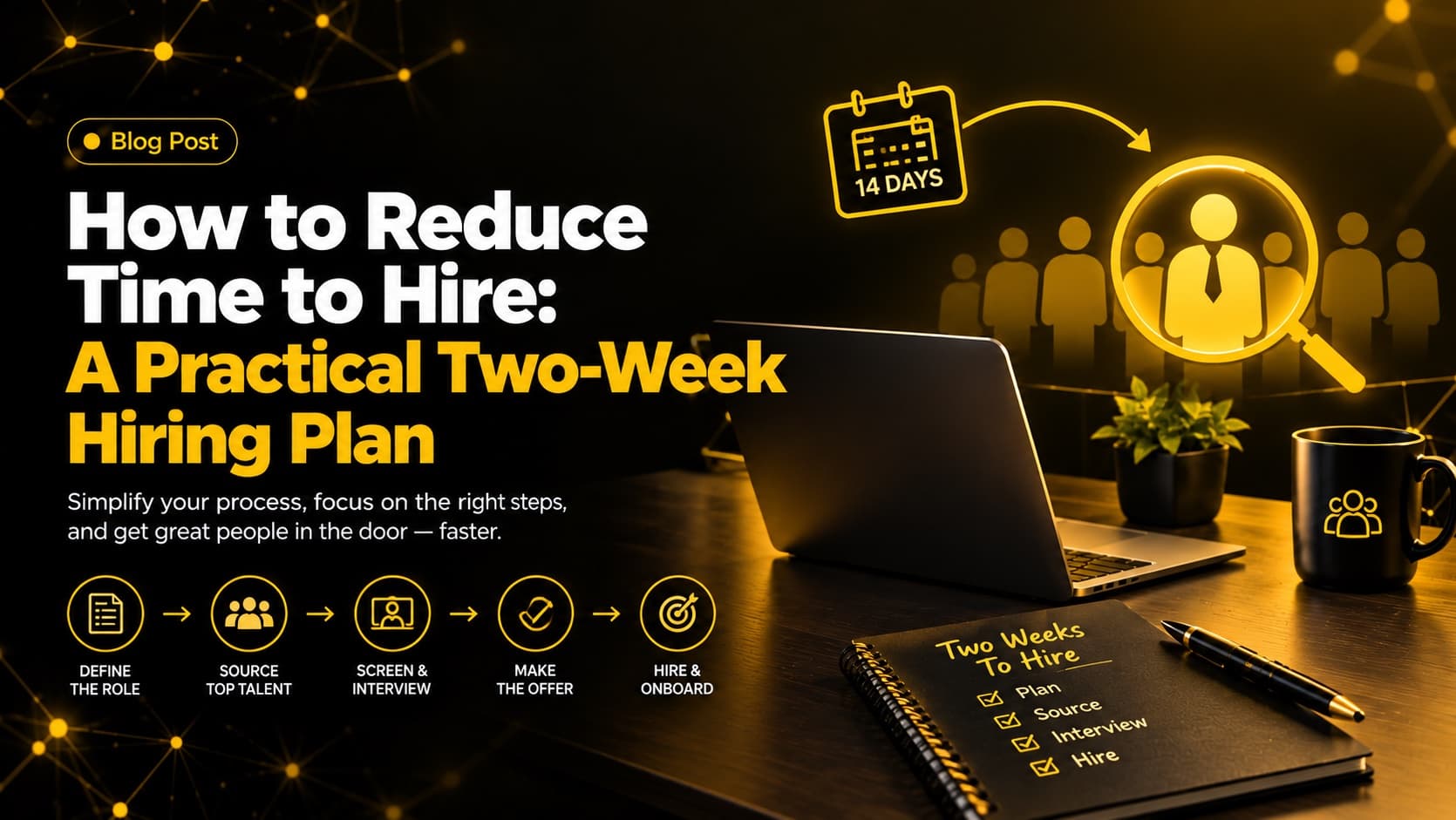
You post the role on a Monday. By the time the offer goes out, six weeks have passed, your best candidate has accepted somewhere else, and the team that needed the hire is still stretched thin. The cause is rarely a lack of good candidates. It is almost always a slow, unclear hiring process.
This guide explains how to reduce time to hire without lowering your standards. You will see what time to hire actually measures, where hiring days really go, six fixes you can apply to your own process, a realistic day-by-day two-week timeline, and the metrics that show whether the changes are working. Everything here is written for growing businesses that hire without a large in-house recruiting team.
What Is Time to Hire?
Time to hire is the number of days between a candidate entering your pipeline (applying or being contacted) and accepting your offer. It tells you how quickly your process moves a person from first contact to a signed yes. It is related to, but different from, time to fill.
| Metric | Starts when | Ends when | Why it matters |
|---|---|---|---|
| Time to hire | The candidate enters your pipeline | The candidate accepts the offer | Shows how fast and organized your selection process is |
| Time to fill | The job opening is approved | The candidate accepts the offer | Shows the full cost of an open role, including preparation |
Swipe the table to see all columns
Both matter, but time to hire is the one you can influence most directly once a role is live. The two-week plan in this guide measures from the day the role is published (Day 1) to an accepted offer (Day 14). The preparation work before Day 1 is done while the role is still being approved, so it sits inside time to fill, not time to hire.
Why a Slow Hiring Process Costs More Than You Think
The Real Cost of an Open Role
Every week a position stays empty, work is either delayed or pushed onto existing employees. That creates three kinds of cost:
- Lost output: tasks the new hire would have owned wait or get done at lower quality.
- Overload on the current team: extra hours lead to fatigue, errors and, over time, resignations.
- Recruiting waste: the longer a search runs, the more interview hours your managers spend, and the more likely you are to restart the search.
These costs are easy to overlook because they never appear as a single line on an invoice. They show up as missed deadlines, tired teams and managers who spend their week on interviews instead of their own work.
Why Strong Candidates Do Not Wait
Candidates with in-demand skills often run several processes at the same time, and the first company to deliver a clear, respectful offer tends to win. A slow process also tells candidates something about how your company makes decisions, and they notice.
What Industry Benchmarks Suggest
Published talent acquisition benchmarks, including SHRM's benchmarking research, consistently show that filling a typical position takes several weeks, and many roles take well over a month from opening to acceptance. Exact figures vary by industry, seniority and year, so treat any single number as a reference point, not a rule. What matters more is how your own process compares with itself: the next section shows you how to measure that.
Where Your Hiring Time Actually Goes
Before you change anything, find out where the days are being lost. In most small and mid-sized companies, the delay is not in one big step. It builds up across the waiting time between steps.
Stage 1: Defining and Approving the Role
Weeks can pass before a job is even posted because the description is unclear, the budget is unconfirmed, or several approvers need to sign off. This is the most avoidable delay in the process.
Stage 2: Sourcing and Screening
Applications arrive, but nobody reviews them promptly. Resumes sit in an inbox for days, and good candidates drift away. Screening without clear criteria also leads to repeated rounds of second-guessing.
Stage 3: Interviewing
Scheduling is the quiet killer. Coordinating three or four interviewers with a candidate's availability can easily add a week or more, especially when each interview round is booked only after the previous one is finished.
Stage 4: Decision and Offer
Even after the final interview, many companies wait for a gut-feeling consensus, then wait again for compensation approval, then draft the offer. Each pause gives a competing employer time to move.
How to Map Your Own Process
Take your last three hires and write down the date of each step: role approved, job posted, first screen, each interview, decision, offer, acceptance. Then mark the longest gaps. You will almost always find that two or three gaps account for most of the delay.
Here is an illustrative example of what that map can look like:
| Step | Days spent | Gap you can fix |
|---|---|---|
| Role approved to job posted | 9 | Agree the description and budget up front |
| Applications waiting for review | 5 | Review every morning |
| Scheduling interviews | 8 | Batch interviews and block calendars |
| Final interview to offer | 6 | Set a 48-hour decision deadline |
Swipe the table to see all columns
In this example, three of the four gaps are waiting time, not evaluation time. Fix the longest one first.
How to Reduce Time to Hire: Six Practical Fixes
These fixes are ordered by the point in the process where they apply. You do not need to adopt all six at once. If you are asking how to speed up hiring quickly, start with the fix that targets your longest gap.
Write a Job Description That Filters as Well as Attracts
A good job description saves days later because it brings in the right applicants and discourages the wrong ones. Keep it specific.
- State the outcomes the person must deliver in the first 90 days.
- Separate true requirements from nice-to-haves, and keep the must-have list short.
- Include the salary range and the work schedule and location. Candidates screen themselves out faster when they can see these details.
- Use the job title people actually search for, not an internal title.
Agree on a Scorecard Before You Post
A scorecard is a short list of the skills and traits that matter, with a simple rating scale for each. Agreeing on it with every interviewer before the role goes live prevents long debates after interviews, because everyone is judging against the same standard.
A simple scorecard includes:
- Three to five core competencies tied to the role's outcomes
- A 1 to 4 rating scale with a short definition for each score
- One line for risks or concerns
- A final recommendation: hire, hold or pass
Pre-Screen With Structured Criteria
Review applications on a fixed schedule, for example every morning, rather than whenever someone has time. Use the same screening questions for every candidate. A brief written question or a 15-minute phone screen is usually enough to decide who moves forward. Respond to every applicant within two working days, even if the answer is no.
Shorten the Hiring Process by Cutting Rounds and Batching Interviews
Most roles do not need four rounds. Two well-designed rounds, combined with a practical task for skilled positions, usually give you the information you need.
A sample two-round structure:
- Round 1 (45 minutes): a structured interview with the hiring manager covering experience, motivation and the core competencies on your scorecard.
- Round 2 (60 minutes): a working session or panel with the team the person will join, plus a short job-relevant exercise.
Batch the interviews. Hold interview days, where several candidates are seen back to back, instead of scattering them across weeks. Block interviewer calendars in advance so scheduling does not become the bottleneck.
Structured interviews, with the same questions asked and scored the same way for every candidate, are also a quality upgrade. Research on selection methods, including Schmidt and Hunter's 1998 meta-analysis and the 2022 update by Sackett and colleagues, places structured interviews among the strongest predictors of job performance. Speed and quality can improve together.
Set Decision Deadlines and Prepare Offers in Advance
Agree internally that a decision will be made within 24 to 48 hours of the final interview. Confirm the compensation range and approvals before interviews begin, so the offer can go out the same day you decide. Call the candidate first, then follow with the written offer. A phone call lets you answer questions immediately and shows the candidate you value them, which helps keep the process moving.
Use a Staffing Partner for a Ready Talent Pipeline
A staffing partner can shorten the earliest stages of the recruitment process because they maintain a pool of pre-screened candidates and handle sourcing, initial screening and interview scheduling. This is not necessary for every role, but it can be valuable in specific situations.
A staffing partner makes sense when:
- You hire infrequently and have no in-house recruiter.
- The role needs to be filled urgently or the skills are hard to find.
- You are scaling quickly and need several hires in a short period.
- Your managers are spending too much time on administration rather than on the interviews that need their judgment.
Need to hire faster without adding to your team's workload?
Our HR and staffing services cover sourcing, screening and recruitment coordination, so your managers can focus on the final decisions. Contact us to talk through your open roles.
A Realistic Two-Week Hiring Timeline, Day by Day
Two weeks is achievable for many roles when the preparation is done in advance. Treat the schedule below as a template to adapt, not a guarantee. Senior, specialist or heavily regulated roles may need longer.
- Before Day 1 (done while the role is being approved): finalize the job description, salary range and scorecard; block interviewer calendars for Days 6 to 9; and pre-approve the compensation range.
| Day | Action | Owner |
|---|---|---|
| Day 1 | Publish the role and share it with your network and any staffing partner. | Hiring manager |
| Days 2 to 3 | Review applications each morning. Send screening questions or hold 15-minute calls. Reply to every applicant. | Hiring manager or HR lead |
| Day 4 | Choose a shortlist of four to six candidates and send interview invitations with specific time slots, giving at least two days' notice. | Hiring manager |
| Day 5 | Confirm interview slots and finish any remaining screens. | HR lead |
| Days 6 to 7 | Round 1 interviews, batched into two focused days. | Hiring manager |
| Day 8 | Score candidates the same day and select two or three finalists. Start reference checks for the finalists. | Interview panel |
| Day 9 | Round 2 interviews with the team and a short practical exercise. Reference checks continue in parallel. | Hiring manager and team |
| Day 10 | Hold a short decision meeting using the scorecard and the completed reference checks. | Interview panel |
| Days 11 to 12 | Call the chosen candidate, send the written offer and answer questions. | Hiring manager |
| Days 13 to 14 | Negotiate if needed, confirm acceptance and tell the other finalists personally. | Hiring manager |
Swipe the table to see all columns
If your shortlisted candidates are currently employed, they may need more than two days' notice to attend an interview. Offering a few early-morning or end-of-day slots keeps the timeline on track without cutting anyone out.
Speed Without Sacrificing Quality
The goal is to remove waiting, not to rush judgment. A faster process should be a more organized one.
Protect the Candidate Experience
Candidate experience is how people feel about your hiring process, whether or not they get the job. Clear communication, prompt replies and respectful feedback leave a good impression, and candidates who were declined may still refer others or apply again. A short status update at each stage costs you almost nothing.
Do Not Skip Reference Checks or Fit Conversations
Shortening the timeline should not mean cutting essential checks. Instead, run them in parallel: start reference checks as soon as finalists are chosen, while they complete Round 2, rather than waiting until a decision is made.
Common Mistakes to Avoid
- Lowering the bar to fill the seat faster
- Skipping the scorecard and relying on impressions
- Making offers without approved compensation, which causes delays and renegotiation
- Going silent on candidates who were not selected
How to Know Whether Your Changes Are Working
Track a few simple numbers for every hire so you can see real progress rather than assume it.
Time to Hire and Time to Fill
Measure both from the same starting point each time. If your time to hire drops but candidates keep rejecting offers, the problem has moved elsewhere in the process.
Offer Acceptance Rate
If most of your offers are accepted, your speed, communication and compensation are probably aligned with the market. A low rate is a signal to review your offer process and your pay range.
Quality of Hire
Check in at 90 days. Ask the manager whether the new employee is meeting the outcomes listed in the job description. This keeps speed and quality tied together.
Related Reading
Hiring is one part of running an efficient business. These guides and services connect it to the wider picture:
- HR and staffing services: how we support sourcing, screening and recruitment coordination.
- Operations cost reduction services: how a shorter, leaner hiring process fits into lowering operating costs.
- Back-Office Support Services: What They Include & How to Improve: how administrative work can run more efficiently so managers have time for hiring decisions.
Final Thoughts
A faster hiring process is not about cutting corners. It is about removing waiting time, deciding in advance what good looks like, and respecting the time of both your team and your candidates. Start by mapping your last three hires, find the longest gap, and fix that one first.
If you would like help building a faster, more reliable hiring process, contact our team or send an inquiry to discuss your hiring needs.
Frequently Asked Questions
What is a good time to hire?
There is no single number that fits every role. Many published benchmarks put the average position at around a month or more from opening to acceptance, so a time to hire of two to three weeks is considered fast for most roles. Entry-level and high-volume roles can move faster; senior and specialist roles often take longer.
What is the difference between time to hire and time to fill?
Time to hire measures the days from when a candidate enters your pipeline to when they accept an offer. Time to fill measures the days from when the job opening is approved to when the offer is accepted. Time to fill includes the preparation period, so it is usually longer.
Can I really hire in under two weeks without lowering quality?
For many roles, yes, as long as the preparation is complete before you post: a clear job description, an agreed scorecard, blocked interview slots and pre-approved compensation. Quality comes from structure, not from slow decision-making.
How many interview rounds should I use?
Two is enough for most positions: one structured interview with the hiring manager and one team or practical session. Add a third only when the role carries unusual risk or seniority, and schedule it quickly.
How can I shorten the hiring process without hurting candidate quality?
Remove waiting time, not evaluation. Agree the scorecard before you post, review applications daily, batch interviews into set days, run reference checks in parallel and set a 24 to 48 hour decision deadline.
When should I use a staffing partner instead of recruiting in-house?
Consider one when you hire rarely, need to fill roles urgently, face a hard-to-find skill set, or want your managers to spend time interviewing rather than sourcing. For ongoing support, see our HR and staffing services.
How do I keep candidates engaged during the process?
Tell them the timeline at the start, reply within two working days, and update them after each stage. Even a short message such as "we are still reviewing, and you will hear from us by Friday" keeps people informed and interested.
Need to Fill Roles Faster?
We handle sourcing, screening and recruitment coordination, so your managers spend their time on the interviews and decisions that matter.
Contact Us Today