
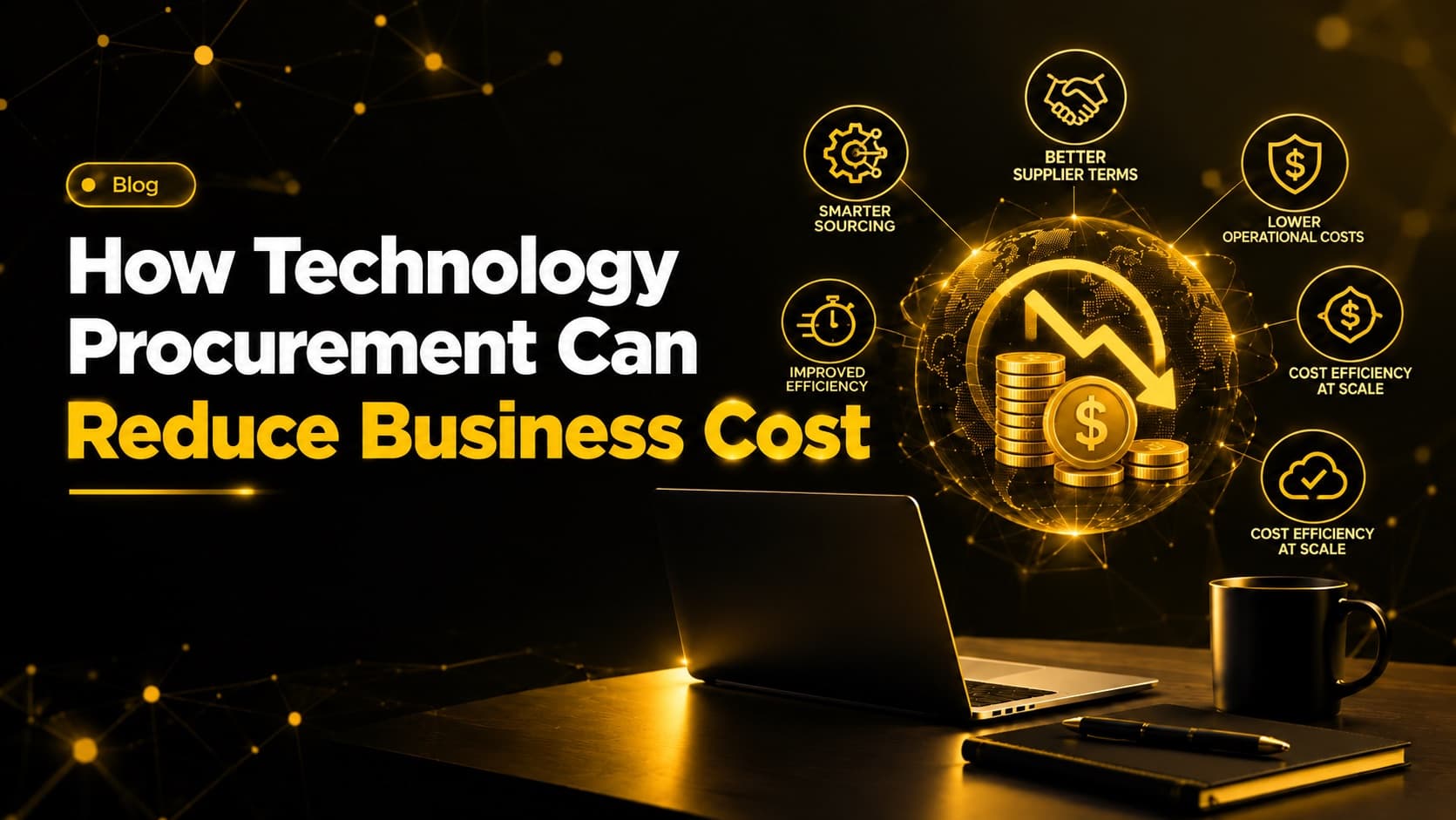
Did you know how many organizations are already paying more for technology than they need to?
The problem often doesn't come from a single device purchase, it's more nuanced and comes from how your business manages technology purchases across the entire procurement process.
When you buy different hardware following similar roles, or you work with too many suppliers, replacing equipment that could have been reused, and letting warranties or support contracts expire, it can all add up to unnecessary costs.
It's where strategic technology procurement can play its role and make a difference.
Technology procurement doesn't always have to follow a structured way to assess what they need, what they already have, which suppliers they should work with, and what each purchase will cost over its useful life.
In this article, we are going to explain how businesses can reduce technology costs through hardware standardization, vendor consolidation, asset audits, and better contract and warranty management.
We will also shed light on how Black Skull typically helps organizations make better purchase decisions based on their actual hardware requirements and meeting their overall budget.
So without further ado, let's begin.
What Is Technology Procurement?
Technology procurement is the strategic process of sourcing, evaluating, purchasing, and managing technology assets, software, and services for an organization.
This sophisticated process fulfills an organization's technical requirements meeting their financial constraints and aligns them with vendor capabilities. The end goal is to ensure a business acquires the right tools at an optimal price, yet at the same time mitigate risk.
How Technology Procurement Reduces Business Costs?
When you opt in for strategic technology procurement from a firm such as Black Skull, our team eliminates software bloat. We secure your organization the best vendor terms and ensure that every tech we obtain directly complements your business's operational requirements. Our end goal is simple, to find you a hardware purchase that best fits your organizational needs and requirements.
There are four key cost reduction mechanisms that we follow at Black Skull during our tech procurement.
Hardware Standardization
Companies often purchase hardware based on individual requests rather than a defined procurement standard. One department may order high-end laptops for employees who only require running basic business applications. While, others purchase different models which may require a separate set of accessories, warranties, and support arrangements (but they only end up purchasing a specific system).
When you onboard Black Skull for tech procurement, our tech procurement team standardizes a specific hardware specification around employee roles and the actual workload they are responsible for.
For example, sales staff may need a different laptop configuration than software developers, designers, or employees who primarily use Microsoft Office and browser-based applications.
Our team will review your existing technology requirements thoroughly and create a purchasing standard based on employee roles. So even if there are 100 employees looking for similar laptops with the same specifications, Black Skull can consolidate the requirements.
Eliminate Shadow IT
Shadow IT happens when employees or departments end up purchasing software, cloud services, devices, or subscriptions skipping the company's existing procurement process. When you do such a thing (skip the procurement consultancy), then there's a bigger problem you're facing. Nobody actually knows or has a complete view of what the company is really paying for. For example, a marketing team might pay for one project-management platform while the sales team uses another. On the other hand, finance wouldn't know about either subscription until the charges appear on a corporate card.
When you reach out to Black Skull, our professional team starts by reviewing your company's existing technology purchases, subscriptions, licenses, etc. Our team finds duplicate tools, non-used subscriptions, purchases which were unauthorized and software which overlaps existing solutions.
Our end goal is to bring these purchases into one procurement process so the business knows what it owns, who uses it, what it costs, and when it renews.
Vendor Consolidation
Many companies often purchase technology through multiple vendors rather than one. It's because different departments make purchases independently. As time passes, it can create a long list of suppliers providing somewhat similar products which can often become troublesome for finance. A business might use one vendor for laptops, another for networking equipment, another for cybersecurity, and several resellers for software licenses.
It can ultimately weaken the company's negotiation position. As a result, the company approaches suppliers with a larger list of requirements where each department negotiates smaller purchases separately.
Vendor consolidation helps with the supplier review process. Effective procurement can move similar purchases to fewer qualified vendors and negotiate based on the company's overall tech budget. At Black Skull, we can review your current vendor list, purchasing history, contracts, and technology requirements and eventually find the unnecessary supplier overlap.
We then compare vendors based on pricing, capabilities, service terms, and business requirements before recommending where consolidation makes commercial sense.
Contract & Warranty Management
Hardware procurement doesn't end when your equipment arrives.
Businesses, in fact, also need to manage other aspects like warranties, maintenance agreements, support contracts, replacement terms, and renewal dates. If these are not tracked properly, companies ultimately end up paying more for repairs or replacements which can otherwise be covered by suppliers or manufacturers. For instance, a business can have around 200 laptops covered in three-year warranties, but if nobody tracks the warranty periods, the company can end up paying hefty amounts for repairs on devices which may still be covered. The same applies to servers, networking equipment, printers, and other business-critical hardware.
At Black Skull, we help businesses maintain visibility over hardware contract and warranty coverage.
Our services, more or less, include purchase dates, warranty periods, service terms, renewal dates, and supplier obligations. Before a warranty or support agreement expires, procurement can check the equipment lifecycle & negotiate the appropriate renewal or replacement terms.
How to Build a Cost-Effective Technology Procurement Strategy?
Here's how you can get your technology spending under control.
Audit the Hardware
Before approving any equipment purchases, find out what devices the company already owns. You can also check where they are located, who is using them, and what condition they are in. Many organizations waste money by simply replacing equipment which could've easily been reassigned, repaired, or upgraded. So first assess what your inventory can hold; laptops, desktops, monitors, servers, networking equipment, printers, and other major assets. Then, check the warranty status before approving any replacement.
Standardize Your Hardware
When you let every employee or department choose different devices, it can increase purchasing, support, maintenance, and replacement costs. Therefore, define a standard hardware specifications for common roles. For example, your administration doesn't need high powered GPU/CPU based laptops, when they can simply work with an average machine. However, your developers, designers, or engineers may require higher-performance systems. When you standardize models, accessories, and specifications, it makes it easier to purchase in volume and gives your IT team fewer hardware configurations to support.
Consolidate Supplier
Purchasing laptops, monitors, servers, networking equipment, and accessories from too many vendors can often weaken negotiating positions. You need to review the current supplier base, find where purchases can be consolidated and while doing it, you don't need to compromise on quality or any such technical requirements. When you have a larger combined order, it gives you more room to negotiate hardware pricing, setting up the delivery terms, get better warranties, installation, support & other additional costs. Your end goal is not to use one supplier for everything; it's to avoid fragmented purchasing when few qualified suppliers can offer better commercial terms.
Manage Contracts
Lastly, manage your contracts where the lowest purchase price does not always mean the lowest possible cost. A device may have additional accessories, installation, maintenance, support, energy requirements, repairs or early replacements. Therefore, you should consider these costs on the expected life of the equipment. For instance, if you go for a cheap laptop which requires frequent repairs or is somewhat already reaching the end of its useful life, it may sooner cost more than a high quality model with a longer warranty and lower maintenance requirements. Your procurement decisions should therefore consider the full lifecycle cost, not just the price on the initial purchase order.
Let Black Skull Help You Reduce Technology Procurement Costs
Technology procurement isn't simply about finding the best possible lowest price for a laptop, server, monitor, or any other piece of equipment.
The real saving comes from making better purchase decisions throughout the entire hardware lifecycle.
At Black Skull, we help businesses take a structured approach to technology procurement. We review your requirements, existing hardware, suppliers, contracts, and purchasing needs to help you make informed procurement decisions. The goal is simple: help you acquire the right technology, at the right terms, without spending more than your business needs to.
If your current technology procurement process is creating unnecessary costs, it may be time to review how you buy, manage, and replace your hardware.
Frequently Asked Questions
How can technology procurement reduce business costs?
Technology procurement can reduce business costs by helping companies identify unnecessary spending, compare supplier quotes, and negotiate better contracts. For example, if a company spends $20,000 per month on technology and identifies 10% in avoidable costs, it could save $24,000 annually. This is an illustrative calculation, not a guaranteed saving. Flexera's 2026 State of the Cloud Report also found that 85% of organizations consider managing cloud spending a major challenge, showing why regular cost reviews matter.
How can businesses compare technology vendors to get the best price?
Businesses should compare vendors based on total cost of ownership rather than the initial purchase price alone. For example, a company buying 50 business laptops might receive a quote of $1,000 per device from Dell and $950 from Lenovo. The Lenovo quote appears $2,500 cheaper overall, but buyers should also compare specifications, warranty coverage, support response times, shipping, and expected maintenance costs before deciding. The better option is the one that meets business requirements at the lowest overall cost.
How much can a business save by reducing unused software licenses?
Savings depend on how many licenses are unused and how much the company pays for them. For example, a business paying $30 per user per month for 200 software licenses spends $72,000 annually. If an audit identifies 25 licenses that are no longer needed, removing them could save $9,000 per year, assuming the licenses can be canceled without additional fees. Businesses should review actual usage, renewal dates, and contract terms before reducing subscriptions.
Is buying cheaper technology always the best way to reduce procurement costs?
No. A cheaper product can become more expensive if it requires frequent repairs, additional support, or early replacement. For example, consider two laptops: Option A costs $900 upfront and $300 in support over three years, while Option B costs $1,050 upfront and $100 in support over the same period. Option A costs $1,200 in total, while Option B costs $1,150. In this example, the more expensive laptop saves $50 over three years. Businesses should compare performance, reliability, warranties, maintenance, and replacement costs before purchasing.
How can businesses reduce cloud and IT infrastructure costs?
Businesses can reduce cloud and infrastructure costs by removing unused resources, rightsizing computing capacity, reviewing software subscriptions, and negotiating suitable pricing commitments with providers such as AWS and Microsoft Azure. Flexera's 2026 State of the Cloud Report estimated that 29% of cloud spending was wasted on average among surveyed organizations. For a company spending $100,000 annually on cloud services, a hypothetical 10% reduction in avoidable spending would mean $10,000 in annual savings. The actual opportunity depends on usage data, technical requirements, and the cost of making changes.
Reduce What You Spend on Technology
Let our procurement specialists review your hardware, suppliers and contracts, and show you where the savings are.
Get a Free Consultation