
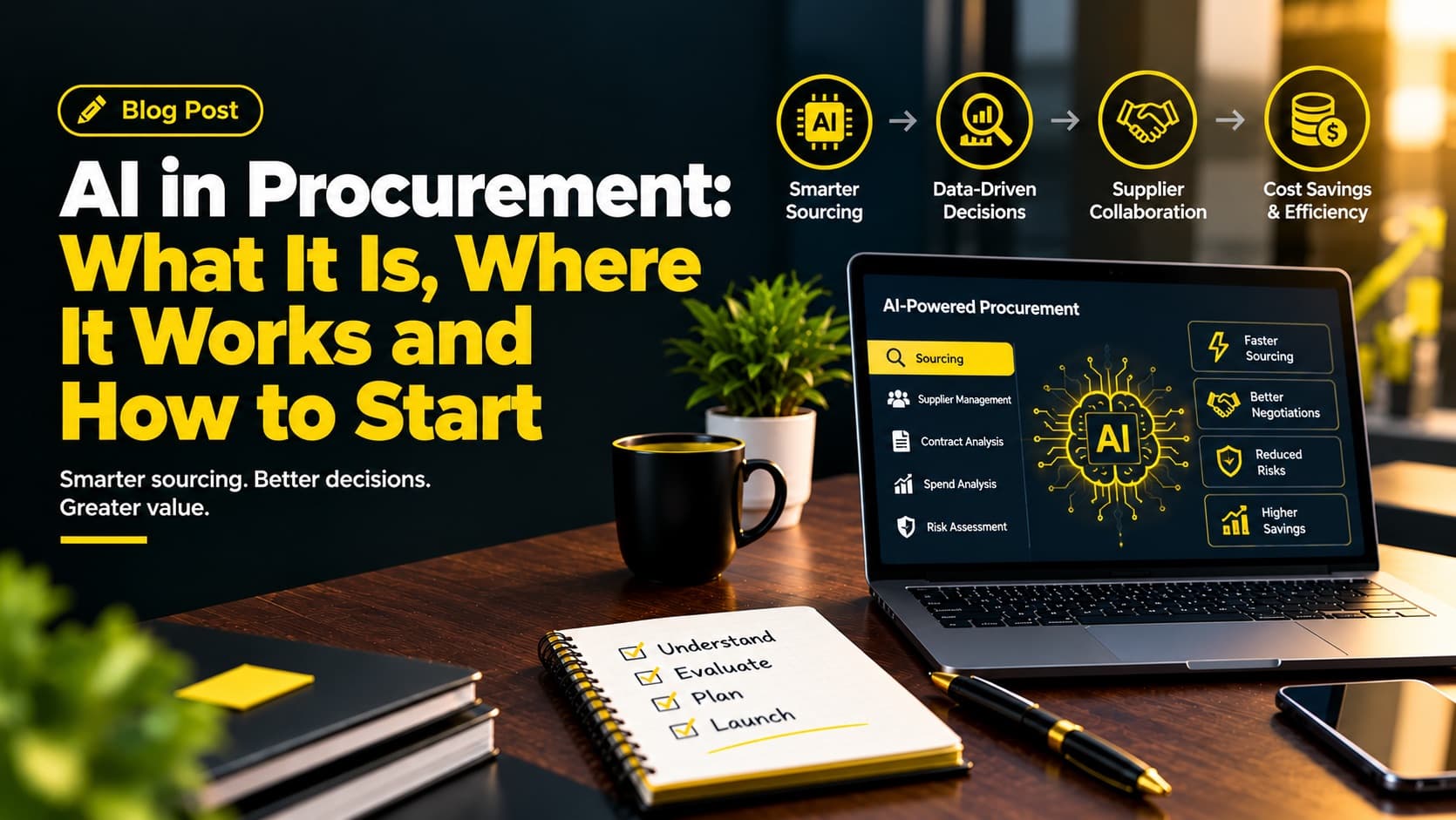
Procurement teams have always worked with more information than they can read. Supplier quotes, contracts, invoices, purchase orders and price lists pile up faster than any buyer can review them. AI in procurement exists to close that gap. It reads, sorts, compares and flags the data buyers used to handle by hand, so people can spend their time on negotiation, supplier relationships and strategy.
The useful question has also changed. It is no longer whether to use AI. It is which parts of the buying process benefit first, what must be true before the tools work, and how to avoid a pilot that never leaves the demo stage.
This guide covers what AI in procurement means, how machine learning, generative AI and agentic AI differ, which use cases pay off earliest, what the research says, and how to start with a 90-day plan. It includes AI procurement tools, AI procurement software and practical AI in procurement examples. If your business buys technology, software or equipment, the sections on data readiness and vendor decisions apply directly to you. For hands-on support, see our technology procurement services.
What Is AI in Procurement?
AI in procurement is the use of artificial intelligence to automate, speed up and improve how an organization finds suppliers, compares offers, signs contracts and pays for goods and services. It usually arrives in one of two ways: AI features built into procurement software, or a general generative AI assistant used for everyday buying tasks.
The key difference from traditional software is judgment at scale. A standard system records what you bought. An AI-enabled system notices patterns and suggests what to do next. It can spot that three departments pay three different vendors for the same software, or warn that a supplier's delivery times have slipped for four straight months.
A few related terms are often confused:
- Procurement automation follows fixed rules, such as routing a purchase request for approval above a set amount. It is useful, but it does not learn.
- Digital procurement is the wider shift from paper and email to connected platforms. AI sits on top of it.
- Procurement analytics turns spend and supplier data into reports. AI adds prediction and recommendations.
- Intelligent procurement is a general label for platforms that combine all of the above. You will also see it called AI-powered procurement.
AI cannot work without the layer beneath it. Clean spend data, a clear approval process and consistent supplier records come first, and that decides more outcomes than the choice of tool.
Types of AI Used in Procurement
Different technologies solve different buying problems. Knowing which one a vendor is selling saves you from paying for the wrong capability.
Machine Learning in Procurement
Machine learning finds patterns in historical data. In procurement, that means classifying spend, predicting price movements, spotting duplicate invoices and scoring supplier performance. It is the most mature type.
Natural Language Processing
Natural language processing (NLP) lets software read text. It extracts payment terms, renewal dates and liability clauses from contracts, and matches vague line items such as "laptops 14 inch" to the right category. Much of what buyers call contract AI is NLP.
Generative AI in Procurement: Common Use Cases
Generative AI creates text from a prompt. The most common generative AI use cases for procurement are drafting requests for proposals, summarizing supplier responses, preparing negotiation briefs and writing supplier emails.
Agentic AI and Procurement AI Agents
Agentic AI carries out a chain of tasks toward a goal within limits you set. Procurement AI agents might collect three quotes, compare them against your criteria, flag exceptions and prepare a purchase order for human approval. Most teams are still early here. An ORO Labs survey of more than 200 executives at companies with over $500 million in revenue found that 73 percent had begun deploying AI agents, but only 49 percent said they clearly understood how agentic AI works.
Robotic Process Automation
Robotic process automation (RPA) is not true AI, but it often works alongside it. It moves data between systems, such as copying invoice details into accounting software, so AI outputs become completed actions.
Where AI Delivers Value Across the Procurement Process
| Procurement stage | What AI does | Typical benefit |
|---|---|---|
| Spend analysis | Classifies and cleans spend data | Visibility into where money goes |
| Sourcing | Finds and shortlists suppliers | Faster, wider vendor selection |
| Quote comparison | Normalizes offers side by side | Fewer pricing blind spots |
| Contract management | Extracts and monitors clauses | Lower legal and renewal risk |
| Supplier risk | Monitors financial and delivery signals | Early warning on problems |
| Purchase-to-pay | Matches orders, receipts and invoices | Fewer errors and late payments |
Swipe the table to see all columns
AI for Spend Analysis
Most teams should start here. AI reads purchase records from different systems, cleans inconsistent supplier names, assigns categories and shows what you really spend with whom. Many companies find duplicate vendors, off-contract buying and widely varying prices for identical items. Fixing those leaks cuts cost without hard negotiation. To see where technology budgets typically leak, read our guide to hidden technology procurement costs.
AI for Sourcing and Supplier Discovery
AI procurement tools can scan supplier databases, match your requirements to capabilities and build a shortlist in minutes. Generative AI then drafts the request for quote and summarizes the replies. Pair this with a vendor quote comparison checklist so every offer is judged on the same criteria.
AI for Contract Management
Contracting is where AI shows its clearest return. In Ironclad's 2025 State of AI in Procurement report, AI for contracting earned an impact score of 8.3 out of 10, making it one of the most reliable and mature applications. Contracts are structured text, and AI reads text quickly. It highlights unusual clauses, tracks renewal and notice dates, and compares new terms with your standard positions.
AI for Supplier Risk
A supplier problem is cheapest to fix before it reaches your operations. AI monitors delivery history, quality issues, financial health and news signals, then alerts you when a vendor starts to drift. Supplier management becomes continuous instead of annual.
AI for Purchase-to-Pay
AI handles the three-way match between purchase order, goods receipt and invoice, flags mismatches and catches duplicate invoices. Teams that want accurate invoicing and data entry can also look at our back-office support services.
AI for Negotiation Support
AI does not replace the negotiator. It supplies preparation: benchmark prices, past terms and a list of leverage points. Our guide on how to negotiate with technology vendors pairs well with this approach.
AI in Procurement Examples
These scenarios are illustrative, not client results.
- Renewal risk. A contract AI tool extracts notice periods from every vendor agreement and alerts the team before an auto-renewal window closes.
- Quote comparison. Three laptop quotes arrive with different warranty, delivery and support terms. A generative AI assistant puts them in one table, and the buyer reviews the exceptions.
- Supplier drift. A monitoring tool flags four straight months of slipping delivery times, so the team lines up a backup vendor early.
- Invoice errors. A three-way match catches an invoice billed for more units than were received, before it is paid.
Hypothetical example with numbers: duplicate software licenses
Three departments each buy a project management tool. Marketing, Sales and Operations each pay a different per-seat rate, and together the three come to $1,125 a month, or $13,500 a year, for 80 seats. An AI spend analysis tool groups the three payments under one category. The buyer consolidates to one contract at $11 per seat for all 80 seats, which comes to $880 a month, or $10,560 a year. The saving is $2,940 a year, about 22 percent, and nothing was cut except duplication. These figures are invented to show the method.
The State of AI in Procurement: What the Numbers Say
Interest is high, but maturity is lower than the headlines suggest.
- Adoption is broad. ORO Labs found that 85 percent of large-enterprise procurement executives were piloting or using AI.
- Maturity is thin. ProcureAbility's survey found that every procurement leader had implemented AI in some capacity, but only 6 percent rated their organization's maturity as advanced, meaning measurable results across procurement functions.
- Most teams are still piloting. In a 2026 survey by HFS Research and Art of Procurement, 38 percent of respondents ran only pilots and proofs of concept, while 15 percent had reimagined procurement with AI at the core. The Hackett Group reports 12 percent at large-scale implementation.
- Most use is general-purpose. Ironclad's 2026 survey found that 64 percent of teams rely on general AI assistants, and 41 percent of AI users combine one with a procurement or contract-specific tool.
- Industry matters. In Ironclad's 2025 report, finance led contract AI adoption at 91 percent while retail sat at 65 percent.
- Many teams are still exploring. Procurement Tactics' 2026 benchmark found that 64 percent of teams had not yet launched a procurement-specific AI initiative.
These surveys use different samples and definitions, so read them as directional. The pattern is consistent: many teams use AI informally, few have built it into governed workflows, and data quality is the usual blocker. That is an opening for small and mid-sized businesses. You do not need an enterprise budget, only a clear starting point and tidy data.
Benefits of AI in Procurement
- Lower cost. Spend visibility, fewer duplicate vendors and better negotiation preparation reduce what you pay. See which operational costs to cut first.
- Faster cycles. Quote requests, comparisons and approvals that took days can take hours.
- Fewer errors. Automated matching and clause checks catch mistakes before they become disputes.
- Stronger compliance. AI flags off-contract purchases as they happen.
- Better supplier decisions. Continuous monitoring replaces annual guesswork.
- More time for strategy. Buyers spend less time on data entry.
AI improves a good process. It rarely rescues a broken one. If approvals are unclear or supplier records are inconsistent, fix those first. Our operations cost reduction services help businesses close process gaps before adding new tools.
Challenges and Risks of AI in Procurement
For the non-AI side, see our guide to technology procurement challenges.
- Poor data quality. AI learns from your data. Inconsistent supplier names, categories and prices produce unreliable outputs. Data preparation is not glamorous, but it is the biggest predictor of success.
- Weak governance. Without rules, staff paste confidential contracts and pricing into public AI tools. Set a policy on what data may be shared, which tools are approved and who reviews output before it reaches a supplier.
- Inaccurate output. Generative AI can state wrong information confidently, so treat it as a strong first draft. Ironclad's 2026 research found that about one in three users spend more time reviewing AI output than it saves them, which is why review steps belong in the workflow from day one.
- Change resistance. Ironclad's 2025 report found that nearly four in five procurement professionals see AI as a career enabler, but only in organizations with a clear AI strategy. Explain what AI will and will not change, and train people early.
- Vendor lock-in. Some platforms are hard to leave once your data is inside. Ask about data export, integration costs and contract length before you sign.
How to Start With AI in Procurement: A 90-Day Roadmap
Days 1 to 30: Get Your Foundations Ready
Gather purchase records, supplier lists and contracts in one place. Remove duplicates, standardize supplier names and assign categories. Write a short AI-use policy covering approved tools and confidential data. Pick one baseline metric, such as average time to complete a purchase or the share of spend under contract.
Days 31 to 60: Pilot One High-Value Use Case
Choose one use case with clear data and a visible result. Spend analysis and contract review are the safest first picks. Run the pilot on one category, such as laptops and monitors, and compare results with your baseline. Keep a person in the loop for every decision.
Days 61 to 90: Measure, Refine and Expand
Count hours saved, errors avoided and savings found. Share the results, fix what failed, then extend the tool to the next category. Only now consider agentic workflows and procurement AI agents.
Not sure where your first pilot should be?
The Black Skull can review your current buying process and point to the quickest win. Book a free consultation.
How to Choose AI Procurement Software
Vendor demos all look impressive. These questions cut through the noise when comparing AI procurement software and AI procurement tools:
- Does it solve a problem we actually have? Match features to your top use case, not a wish list.
- How does it handle our data? Check integrations with your accounting, ERP or purchasing tools, and where data is stored.
- Can we see how it reached a recommendation? Explainable output builds trust and supports audits.
- What does total cost look like? Include setup, training, integrations and renewal terms.
- Can we leave? Make sure you can export your data in a usable format.
- Who owns the outcome? Assign an internal owner. Software does not manage itself.
Smaller teams can start with a general AI assistant for drafting and summarizing, and add specialized tools only when volume justifies it. Score vendors consistently with our vendor quote comparison checklist.
Where AI in Procurement Is Heading
Three trends are worth watching. Agentic AI will take on more routine steps, with people approving exceptions. AI will connect procurement with finance and operations, so buying reflects budgets and demand in real time. And governance will matter more as regulators and customers ask how automated decisions are made. The businesses that benefit most will have clean data, clear rules and buyers who know how to question what the software tells them.
Final Thoughts: Start Small, Fix the Data, Keep People in Charge
AI in procurement is no longer a distant idea, but it is not magic either. It rewards teams that prepare their data, set simple rules and pick one problem to solve well. Start with spend analysis or contract review, measure the result and build from there.
If you want help getting technology purchases under control, The Black Skull supports businesses with technology procurement, vendor negotiation and workflow improvement. Book a consultation to review your current buying process and find the first place AI can save you time and money.
Frequently Asked Questions
What is AI in procurement in simple terms?
It is the use of artificial intelligence to help with buying tasks such as analyzing spend, comparing quotes, reviewing contracts and monitoring suppliers. The software handles repetitive reading and matching, and people make the decisions.
What are the main use cases of AI in procurement?
The most common are spend analysis, supplier discovery, contract management, supplier risk monitoring, invoice matching and negotiation preparation. Spend analysis and contract review usually deliver value first.
How is generative AI used in procurement?
Buyers use it to draft requests for proposals, summarize supplier responses, write emails and prepare negotiation briefs. A person should review every output before use.
What is agentic AI in procurement?
Agentic AI completes a multi-step task toward a goal, such as collecting quotes, comparing them and preparing an order for approval. Procurement AI agents are still early in most organizations, which keep human approval in place.
What are some examples of AI in procurement?
Common examples include finding duplicate software licenses through spend analysis, flagging contract renewal dates, normalizing supplier quotes, monitoring delivery performance and catching invoice mismatches before payment.
Is AI in procurement only for large enterprises?
No. Smaller businesses can start with spend analysis, contract review and a general AI assistant. The main requirement is organized data, not a large budget.
What are the risks of using AI in procurement?
The main risks are poor data quality, weak governance, inaccurate output, staff resistance and vendor lock-in. A written policy, human review and a small pilot reduce all five.
How do I know if my business is ready for AI in procurement?
You are ready when your spend data is reasonably clean, your approval process is clear and you can name one specific problem to solve. If those are missing, begin with data cleanup.
Will AI replace procurement professionals?
It is far more likely to change the job than remove it. Routine tasks shrink, while negotiation, relationship management and category strategy grow in importance.
Want AI to Pay Off on Your Next Purchase?
We review your buying process, tidy the data behind it and point to the use case that will show a result first.
Contact Us Today