
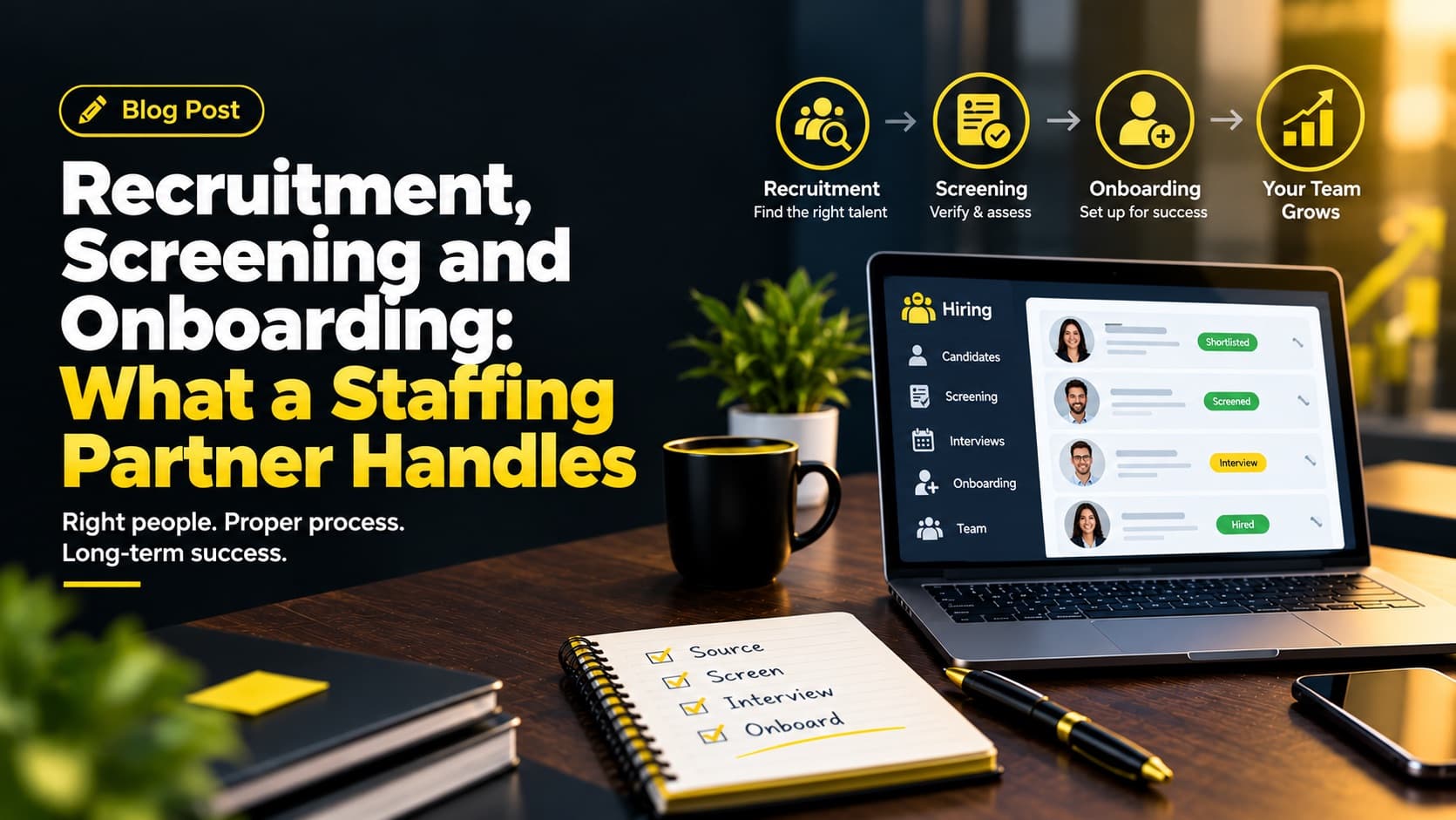
Hiring rarely fails because a business picked the wrong job title. It fails in the gaps: a role brief that was never written down, a shortlist built from keywords instead of skills, a reference check that was skipped because the offer was urgent, or a new starter who spent day one waiting for a laptop. Each gap looks small. Together they cost weeks of lost time, a weaker team and, too often, a second round of hiring six months later.
This guide explains how recruitment, screening and onboarding work as one connected process, and what a staffing partner (the term we use for a staffing agency that takes responsibility for the whole result) handles at each stage. It is written for owners, office managers and HR leads who are deciding whether to hire with outside help. By the end you will know what a staffing partner does, what it typically costs, what stays with your business and what to ask before you sign anything.
The short answer
A staffing partner defines the role with you, finds and screens candidates, verifies their background, supports the offer and helps the new hire settle in. You keep the final decision, the culture and your legal responsibilities as the employer.
What Is a Staffing Partner?
A staffing partner is an organization that manages part or all of your hiring process on your behalf. Instead of posting a job advert and sorting through applications yourself, you work with a team that understands your role, finds suitable candidates, checks them properly and helps them settle into your business.
Many people search for a "staffing agency" or "recruitment agency", and the services overlap. The difference is in the scope of responsibility. A transactional staffing agency sends you a pile of CVs and moves on. A staffing partner takes responsibility for the quality of the whole result: the right person, in the right seat, still doing well after the first three months. If you are comparing providers, that difference is the first thing to test.
Staffing Partner vs Job Boards vs In-House Hiring
Each route has a place. The right choice depends on volume, urgency and how much hiring knowledge your team already has.
| Factor | Job boards | In-house hiring | Staffing partner |
|---|---|---|---|
| Best for | Wide reach on a low budget | Frequent hiring with a dedicated HR team | Growing businesses that hire in bursts or have no spare hours |
| Who reads applications | You | Your HR team | The partner, against your candidate profile |
| Screening and checks | You arrange them | Your team arranges them | The partner coordinates them |
| Speed to first shortlist | Depends on response to the advert | Depends on team capacity | Often faster, thanks to a pre-assessed talent pool |
| Control | Full | Full | Shared: they recommend, you decide |
| Main drawback | Heavy workload for you | Fixed cost of an HR function | Fees, and the need to brief the partner well |
Swipe the table to see all columns
Who Benefits Most From Staffing Services
Small and mid-sized companies get the most visible gain. A founder who is also the head of operations rarely has ten free hours to review applicants. A business opening a second location may need several hires within weeks. A team that has just lost a key person needs a replacement without losing momentum. In each case, staffing services turn hiring from a distraction into a managed project.
Here is a scenario. A 12-person services firm opens a second office and needs three coordinators within a month. The owner is also running sales. Handing the intake, screening and scheduling to an outside team means the owner's time goes to two things only: the interviews and the final decisions. (This is a composite example, not a named client.)
The Three Stages: How Recruitment, Screening and Onboarding Connect
These three stages are often treated as separate jobs, handled by different people with different notes. That is where information gets lost. What you learn about a candidate during recruitment should shape the questions asked during screening, and what screening reveals should shape the first weeks of onboarding.
A good staffing partner treats the recruitment process as a single chain. Where each stage hands work to the next:
| Stage | What it produces | What it passes to the next stage |
|---|---|---|
| 1. Recruitment | A defined role and a shortlist of fitting candidates | The candidate profile and the open questions about each person |
| 2. Screening | Verified skills, references and background | Strengths to build on and gaps to cover in training |
| 3. Onboarding | A settled, productive employee | Feedback that sharpens the next hire |
Swipe the table to see all columns
The sections below follow that chain.
Recruitment: Finding the Right Candidates
Recruitment is more than advertising a vacancy. It is the work of understanding what your business needs and then reaching people who can deliver it. This is where most hiring problems begin, because an unclear brief produces unclear results.
Step 1: The Role Intake and Briefing
Everything starts with a conversation. A staffing partner will ask what the role must achieve in the first six months, which tasks fill most of the week, who the person reports to and what has gone wrong with this role in the past. They will also ask about the things job descriptions usually leave out: team culture, working hours, how decisions get made and what a good first month looks like.
This intake is the foundation of the whole recruitment process. A role described in terms of outcomes, not just duties, is far easier to match with the right person.
Step 2: Job Description and Candidate Profile
Once the brief is clear, the partner drafts a job description and a separate candidate profile. They are not the same thing. The job description is what candidates read. The candidate profile is the internal checklist of must-have skills, nice-to-have skills, experience level, salary range and deal-breakers that guides every later decision.
Keeping the two apart prevents a common mistake: advertising a wish list so long that strong candidates talk themselves out of applying.
Step 3: Sourcing and Attracting Candidates
Strong candidates are not always actively looking. A staffing partner combines several channels:
- Their existing talent network of people already interviewed and assessed.
- Advertising on job boards and professional networks, with wording written for the specific role.
- Direct approach, where the recruiter contacts suitable people who have not applied.
- Referrals from previous placements and client contacts.
Because the partner already holds a pool of pre-assessed people, the first shortlist can often be ready far sooner than a fresh advertisement would produce. For context, SHRM's 2026 recruiting benchmarking puts the median time-to-fill for non-executive positions at 39 calendar days. If you want to beat that, our guide on how to reduce time to hire lays out a practical two-week hiring plan.
Step 4: Shortlisting and Presenting Candidates
The output of recruitment is not a stack of CVs. It is a short list of people who meet the candidate profile, each with a summary of why they fit, what questions remain and what they expect in terms of pay and start date. Your team then spends its time on interviews with qualified people, not on sorting through applications.
Candidate Screening: Checking Before You Commit
Candidate screening is where a staffing partner protects you from expensive mistakes. A polished CV and a confident interview prove very little on their own. Screening adds evidence.
Application and CV Review
The first pass checks that the candidate's experience matches the profile. A trained reviewer looks beyond keywords to patterns: how long the person stayed in each role, whether responsibilities grew over time and whether gaps have a reasonable explanation. Gaps are not automatically a problem, but they should be understood.
Initial Screening Call
A short structured call covers the basics before anyone's time is spent on a full interview: availability, salary expectations, notice period, location or travel needs and motivation for the move. This stage removes mismatches early and spares both sides a wasted interview.
Skills and Competency Assessment
Where the role calls for a specific skill, the partner tests it. That might be a data entry accuracy test, a scheduling exercise, a short written task, a software proficiency check or a scenario question about handling a difficult customer. The goal is to see work, not just hear claims about it.
Structured Interviews
A structured interview asks every candidate the same core questions and scores the answers against agreed criteria. This keeps the process fairer and makes comparison easier, because you are judging evidence rather than first impressions. Personal chemistry can pull harder than it should, and a scoring sheet is a simple way to balance it.
Pre-Employment Screening and Background Checks
Pre-employment screening confirms that what a candidate has told you is accurate. The specific checks depend on the role, the industry and the laws where you operate, but commonly include the following.
- Identity and right-to-work verification. Confirming that the person is who they say they are and is legally permitted to take the job. In the United States this means Form I-9, and employers must complete their section within three business days of the employee's first day of work, as set out in the USCIS Handbook for Employers (M-274).
- Employment history and reference checks. Speaking to previous employers to confirm job titles, dates and, where possible, performance and reliability. A reference call asks specific questions about the work, not just whether the person was "good".
- Education and professional credential verification. Checking qualifications, licences and certifications, which matters most for roles that require them by law or by contract.
- Criminal record and other background checks. Where lawful and relevant to the role, such as positions involving money, sensitive data or vulnerable people. Rules on what you may check, and when, differ by location, so a staffing partner should apply them carefully and with the candidate's consent.
Staying Compliant During Screening
Screening carries legal responsibility. Employers must avoid discrimination, handle personal data properly and follow local hiring regulations. In the US, the EEOC and FTC publish joint guidance, Background Checks: What Employers Need to Know, which stresses treating all candidates the same way and getting written permission before obtaining a report from a third-party screening company. The FTC adds that if you may decline a candidate because of a screening report, the Fair Credit Reporting Act requires a pre-adverse action notice first. Its business guidance on FCRA notice and consent explains the sequence.
A knowledgeable partner builds these requirements into the process by using consistent criteria, recording the reason for each decision and storing candidate information securely. Ask which checks they run and which laws they follow, and seek legal advice for anything specific to your situation. Keeping tidy candidate records also helps here; our post on CRM updates and data entry shows why clean records make better decisions.
Onboarding: Turning an Accepted Offer Into a Productive Employee
Many businesses treat the signed offer as the finish line. It is closer to the halfway mark. The weeks after acceptance are when a new hire decides whether they made the right choice, and when your business finds out whether it did.
The data backs this up. Gallup reports that only 12% of US employees say their company does a good job of onboarding, and that when the manager takes an active role in onboarding, employees are 3.4 times as likely to feel their onboarding process was successful.
Offer, Negotiation and Paperwork
A staffing partner usually helps manage the offer stage. That includes confirming salary and terms, handling counter-offers, preparing the contract, collecting the required documents and keeping the candidate informed. Long silence between offer and start date can make a new hire reconsider, so steady communication is part of the service.
Pre-Boarding: The Gap Between Acceptance and Day One
Pre-boarding covers everything that should be ready before the person arrives:
- A confirmed start date, time and location, with a named person to meet them.
- Equipment, accounts and system access set up in advance.
- A welcome message and a simple first-week schedule.
- Forms and policy documents sent early, so day one is not spent on paperwork.
This is where admin discipline pays off. Our overview of back-office support services covers the documents, scheduling and records that keep onboarding smooth. If your business buys its own equipment, the vendor quote comparison checklist helps you have devices ready without overspending.
The First Week: Orientation and Introductions
The first week is about belonging and clarity. A good new hire onboarding plan introduces the team, explains how work flows through the business, sets out who to ask for what and gives the person one or two small tasks they can finish and feel good about. Handing someone a manual and a login on day one is not onboarding.
Training and Role Clarity
New employees perform better when they know exactly what success looks like. That means written expectations for the first 30, 60 and 90 days, access to the tools and processes they need and a manager who checks in regularly. Your staffing partner can help draft these milestones from the original role brief, since they already know what the job was designed to achieve.
Follow-Up Check-Ins After Placement
A responsible partner does not disappear after the start date. Check-ins at the end of the first week, the first month and around the 90-day point give both the employee and the manager a neutral channel to raise concerns early. Small problems, such as unclear priorities or a mismatch in working style, are far cheaper to fix in week three than in month six.
What Stays With Your Business
A staffing partner can carry a large share of the work, but not all of it. Being honest about the split makes the relationship work better.
| Task | Staffing partner | Your business |
|---|---|---|
| Role intake and candidate profile | Leads, drafts documents | Provides context and signs off |
| Sourcing and shortlisting | Leads | Gives feedback on each shortlist |
| Screening and background checks | Coordinates and records | Confirms which checks apply and remains legally responsible |
| Interviews | Schedules and scores | Joins and makes the final decision |
| Offer and paperwork | Supports and communicates | Issues the contract, pay and terms |
| Onboarding | Prepares documents and check-ins | Manages day-to-day, culture and training |
Swipe the table to see all columns
Three points deserve emphasis:
- The final decision is yours. The partner recommends. You choose.
- You remain the employer. Contracts, pay, working conditions and legal obligations stay with your business, so confirm in writing exactly who is responsible for what.
- Honest feedback sharpens results. The more you tell your partner about why you rejected a candidate, the better their next shortlist.
Think of it as shared ownership of one process: the partner handles the heavy lifting of finding, checking and preparing, and you provide the context, the decision and the welcome.
Planning a hire and not sure which stage to hand over?
Our HR and staffing services team can walk through your role and show you where outside help saves the most time. Book a consultation.
How Much Does a Staffing Partner Cost?
Pricing varies by provider, role and level of service, so treat any single figure with caution. The most common fee models are:
- Placement fee. A percentage of the hired person's first-year salary, usually paid only when you hire.
- Retained or staged fee. Part of the fee is paid up front and the rest at set milestones, common for senior or hard-to-fill roles.
- Flat fee per hire. A fixed price agreed in advance, which makes budgeting simple.
- Hourly rate with markup. Used for temporary and contract staff, where the partner employs the worker and bills you for their time.
When comparing quotes, look past the headline number. Ask what the fee includes, whether screening and background checks cost extra, and what the replacement or refund terms are if a hire leaves early. Then weigh the fee against the real cost of doing it yourself: owner and manager hours, a vacancy that stays open and a mis-hire that has to be repeated. Our guide to hidden overhead costs is a useful lens for that comparison.
How to Choose the Right Staffing Partner
Not every provider, whether a staffing agency or a specialist firm, handles all three stages equally well. Some are strong at finding candidates and light on screening or onboarding. Before you commit, ask direct questions.
Questions Worth Asking
- Which of the three stages do you handle yourselves, and which do you leave to us?
- What screening and background checks are included, and which cost extra?
- How do you record and explain why a candidate was or was not shortlisted?
- How do you handle data protection and candidate consent?
- What happens if a hire leaves early? Is there a replacement or review arrangement?
- Who will be my day-to-day contact, and how often will we speak?
Signs of a Good Fit
A good partner asks more questions than you expect during the first conversation, explains their process plainly, gives realistic timelines instead of promises that sound too fast and is willing to put the scope of their work in writing. Be cautious of anyone who guarantees a perfect hire or cannot describe how they screen.
Common Hiring Mistakes a Staffing Partner Helps You Avoid
- Hiring without a clear brief. Vague roles attract vague candidates.
- Skipping reference and background checks under time pressure. The shortcut often costs more than the delay.
- Judging on chemistry alone. Structured scoring reduces the pull of first impressions.
- Leaving new hires alone in week one. Early disengagement is hard to reverse.
- Treating the three stages as separate jobs. Notes from recruitment and screening should flow straight into onboarding.
How The Black Skull Supports Hiring
Through our HR and staffing services, The Black Skull supports recruitment, placement and ongoing HR support. We pair that with back-office support, including administrative work, data entry and CRM upkeep, so hiring does not compete with the rest of your daily work.
In practice, we help you clarify the role, coordinate the recruitment process, organize screening and keep onboarding documents and schedules in order. Your team spends its time on interviews and on welcoming the person you choose. You remain the employer and make the final hiring decision, and we will confirm in writing which tasks we take on before work begins.
Ready to talk it through?
Book a hiring consultation and bring your role description, even a rough one, and your target start date. We will map which stages to hand over and what a realistic timeline looks like.
Conclusion
Recruitment, screening and onboarding work best when they are treated as one connected process. Recruitment finds people who fit the role. Screening confirms the evidence behind the fit. Onboarding turns a signed offer into a confident, productive team member. A staffing partner covers the practical work at each stage, while your business keeps the final decision, the culture and the day-to-day relationship.
Before your next hire, write down the outcomes the role must deliver, decide which of the three stages you most need help with and ask any provider to show you exactly how they handle it. If you would like a second pair of eyes on that plan, book a consultation with The Black Skull.
Frequently Asked Questions
What does a staffing partner do?
A staffing partner manages hiring tasks on your behalf. These typically include defining the role, sourcing candidates, screening and interviewing them, checking references and backgrounds, supporting the offer and helping the new employee settle in during onboarding.
What is the difference between a staffing partner and a staffing agency?
The terms overlap, and many providers use them interchangeably. In practice, a staffing agency often focuses on supplying candidates, while a staffing partner also takes responsibility for screening, onboarding and follow-up so the hire succeeds after the start date. Ask any provider to describe exactly which stages they cover.
What is the difference between recruitment and screening?
Recruitment is the process of finding and attracting candidates who might suit the role. Screening is the process of testing and verifying those candidates, through skills assessments, structured interviews and background checks, to confirm they are right for the job.
What is included in pre-employment screening?
It varies by role and location, but commonly includes identity and right-to-work verification, employment and reference checks and confirmation of qualifications. Criminal record checks are used only where the law allows and the role justifies them.
How long does the recruitment process usually take?
SHRM's 2026 benchmarking reports a median of 39 calendar days to fill non-executive positions, which is a useful planning figure of roughly five to six weeks. Senior roles usually take longer, and notice periods can add further time before the start date. A clear brief, a prepared shortlist and prompt interview scheduling are the biggest factors in shortening the process.
How much does a staffing partner cost?
It depends on the fee model. Common options are a percentage of first-year salary on hire, a retained fee paid in stages, a flat fee per hire or an hourly rate with markup for temporary staff. Ask what is included, what costs extra and what happens if the hire leaves early.
Why is onboarding part of a staffing partner's work?
Because a hire is only successful if the person stays and performs. Preparing documents, equipment and a first-week plan, and checking in afterwards, protects the effort already invested in finding and screening them.
Do small businesses need a staffing partner?
Not always. If you hire rarely and have time to manage the process yourself, you may not. But small teams often benefit most, since hiring competes directly with the owner's or manager's other responsibilities.
Who is responsible for compliance in hiring?
Responsibility is shared but not equal. A good partner follows compliant practices in screening and data handling, while legal accountability as the employer stays with you. Confirm the split in writing and take legal advice on specific questions.
Planning a Hire and Short on Hours?
We support recruitment, screening coordination and onboarding, so your team spends its time on interviews and on welcoming the person you choose.
Contact Us Today