
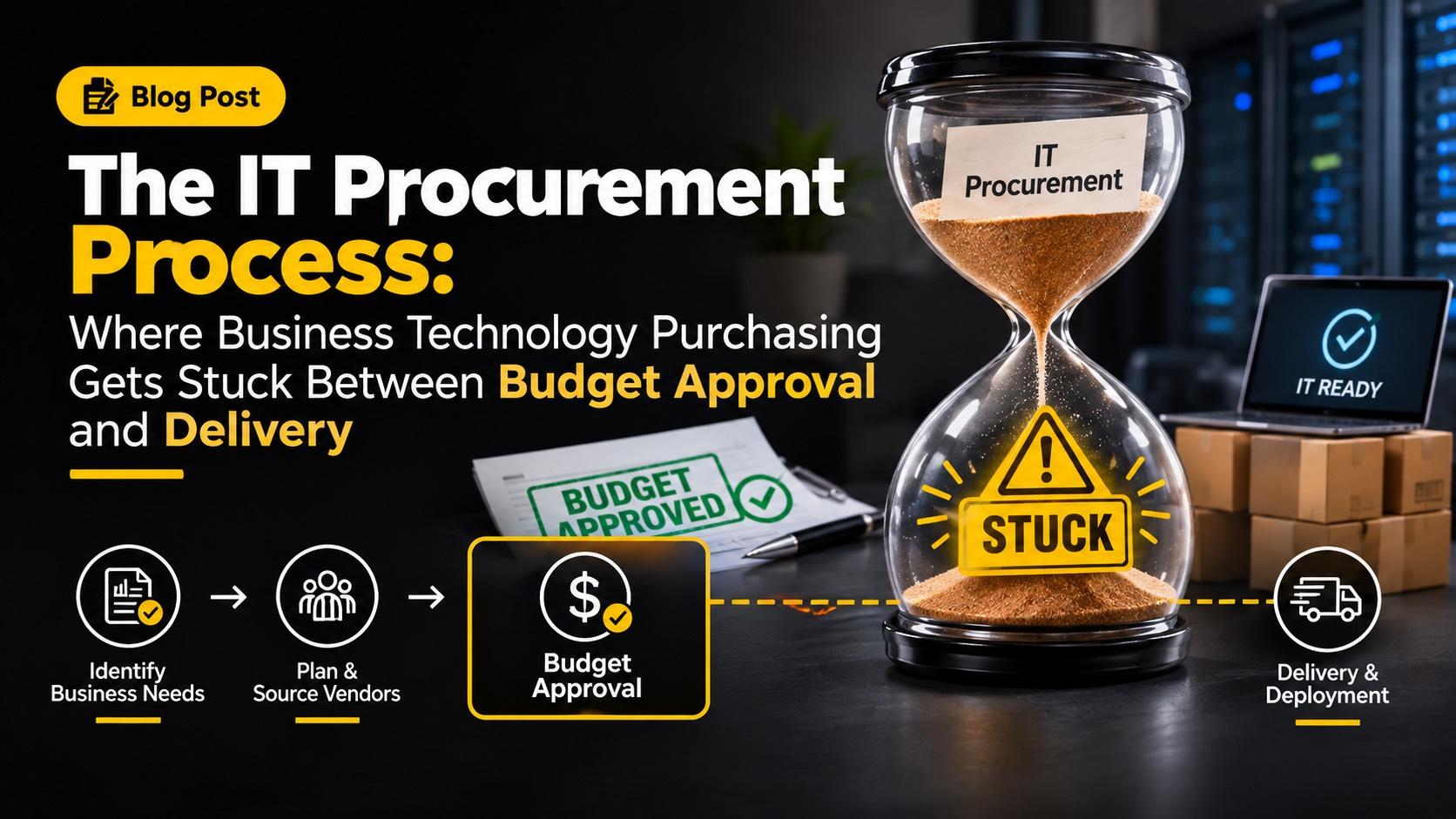
Budget approval feels like the finish line for a technology purchase. In the IT procurement process, it is actually the starting gun. Once the money is allocated, the business still has to settle hardware requirements, collect vendor quotes, compare configurations, confirm stock, issue a purchase order and get devices delivered to the right people in the right locations. A delay at any of those steps can push back employee onboarding, stall an IT upgrade and leave finance explaining why an approved purchase is still not on anyone's desk.
This guide walks through the IT procurement process from approved budget to delivered hardware. It shows the six stages where business technology procurement most often stalls, explains why each one happens, and gives you a practical way to prevent each bottleneck before it affects operations.
Understanding the Business IT Procurement Process
Technology procurement is the chain of decisions and handoffs that turns a business need, such as 40 laptops for a new team, into working devices in employees' hands. The technology purchasing process usually involves IT, finance, department heads, a purchasing or procurement lead and one or more suppliers. Each group owns a piece of the work, and most delays happen at the handoffs between them.
It helps to separate two kinds of delay from the start. Internal delays come from inside the business: unclear specifications, slow approvals, late purchase orders. External delays come from suppliers and carriers: slow quotes, limited stock, shipping problems. A business can fix internal delays directly. External delays can only be anticipated and managed. Treating the two as one problem is a common reason procurement teams repeat the same mistakes on every order. For a broader overview of the issues businesses run into, see our guide to technology procurement challenges.
Defining Technology Requirements
Every purchase starts with a clear statement of what is needed, for whom and in what quantity. For laptop and desktop procurement, that means matching hardware configurations to employee roles. A finance team working in large spreadsheets needs different memory and screen setups than a front-desk team using a few web applications. It also means settling quantities, the budget per device and which purchases come first.
Requirements that are written down make every later stage faster. Requirements that live in people's heads are where most delays begin.
Budget Approval and Purchasing Authorization
Budget approval confirms how much can be spent. Purchasing authorization confirms who can spend it and on what. These are not always the same step, and the gap between them is where purchases quietly wait.
An approved budget built on assumed prices may need a second review once real quotes arrive. Requirements that change after approval, such as a department adding five new hires, can trigger another round of sign-offs. Keeping the approved scope and the actual purchase request aligned prevents that loop.
6 Common Stages Where Business Technology Procurement Gets Stuck
The six stages below follow the order of the IT procurement process. For each one, you will see what goes wrong, why it happens and what to do about it. These are the procurement bottlenecks that cause most IT procurement delays.
Unclear Hardware Requirements
Picture an operations manager who requests 30 laptops for a hiring push. IT assumes standard office models. Finance expects the lowest price. Two weeks later, the sales director asks for larger screens and more memory for the new team, and the request goes back to the start.
- Why it happens: Specifications are incomplete, departments have different needs, and quantities or configurations change after the first request goes out. Every change forces suppliers to requote and approvers to review again.
- How to prevent it: Define a short list of approved configurations by role. Confirm quantities with department heads before requesting quotes. Set a cutoff date after which changes move to the next order instead of the current one. This is an internal bottleneck, so the fix is internal too.
Delays in Collecting Vendor Quotes
Once requirements are clear, the business needs prices. This is where IT hardware procurement first depends on people outside the company. A buyer who asks three suppliers for the same 30 laptops may get one quote in a day, one in a week and one that quotes a different processor.
- Why it happens: It can be hard to identify suppliers that handle a particular volume or product line. Responses are slow, and each supplier formats its quote differently, so key details like configuration, stock status and lead time are missing or buried.
- How to prevent it: Send every supplier the same written specification and the same response deadline. Ask for itemized pricing, stock status and delivery lead time in every reply. Keep a shortlist of suppliers that have responded reliably on past orders. The delay is external, but the quality of your request is internal and largely decides how fast quotes come back.
Challenges in Comparing Vendor Proposals
Having quotes in hand does not mean the business is ready to decide. One supplier bundles shipping and setup into the unit price while another lists them separately. One offers a one-year warranty and another three years with next-business-day support. Two laptops with similar names can differ in memory, storage or processor generation.
- Why it happens: Pricing structures, warranty terms and support coverage are not standardized, and truly equivalent configurations are rare. Without a shared format, the team ends up comparing numbers that do not mean the same thing.
- How to prevent it: Effective vendor quote comparison starts with a fixed set of rows: specification, unit price, total cost including shipping and setup, warranty and support, availability and delivery commitment. Convert every quote to the same configuration before judging price. The lowest sticker price is not always the lowest total cost, especially when warranty and delivery terms differ. Using a total cost of ownership approach, which counts everything it takes to buy and run a product rather than just the quoted price, is a standard way to compare suppliers fairly.
Supplier Availability and Hardware Sourcing Delays
The approved model may not be available in the quantity needed. A supplier might hold 12 of the 30 units, or discontinue a configuration between quote and order. When availability forces a substitution, the replacement often has to be approved again, which sends the order back to requirements or comparison.
- Why it happens: Bulk orders put pressure on supplier inventory, product lines change, and stock levels shift faster than approval cycles. This is the most common external bottleneck in hardware sourcing for businesses. Market conditions can make it worse: Gartner expects surging memory costs to push average PC prices about 17% above 2025 levels and to narrow the range of devices available, which leaves fewer fallback options when a configuration runs short. Our guide to rising hardware prices and your IT budget explains how to plan around this.
- How to prevent it: Confirm stock and lead times at the quote stage, not after approval. Pre-approve acceptable alternatives, for example any model that meets a defined minimum specification. For large orders, consider splitting the purchase across suppliers when one cannot cover the full quantity.
Delays in Purchase Orders and Vendor Coordination
This stage mixes internal and external friction. Internally, the purchase order may wait for authorization or be built from an outdated quote. Externally, the supplier may reject or hold an order because a detail does not match. A buyer may assume an order is confirmed while the supplier is still waiting for a signed document.
- Why it happens: Responsibilities are unclear, approvers are not given expected response times, and communication runs through scattered email threads. Gaps between buyer and supplier look small but can stall an order for days.
- How to prevent it: Name one owner for each order. Use a purchase order template that carries the quote number, configuration, quantity, price, delivery address and requested date. Confirm receipt of the purchase order with the supplier in writing, and agree internally on how quickly approvers are expected to respond.
Shipping, Delivery and Deployment Issues
The final stage is often the least planned. Consider an order of 60 laptops for three offices. Forty-five arrive at headquarters, 15 are backordered, and two of the other offices have onboarding dates this week. The purchase is technically in progress, but the people who need devices have none.
- Why it happens: Delivery timelines are unclear, multiple locations complicate shipping, deliveries arrive late or incomplete, and nobody has planned who receives, tags, configures and assigns the devices. Orders that span several offices bring their own coordination challenges; see our guide to bulk technology ordering for multi-site businesses.
- How to prevent it: Ask for delivery schedules by location when the order is placed. Decide in advance whether partial shipments are acceptable and how they will be prioritized. Plan receiving and deployment, including asset tagging, setup and user assignment, before the devices arrive. Asset tagging also pays off beyond day one, because the NIST Cybersecurity Framework lists maintaining an inventory of the hardware you manage as a core outcome (ID.AM-01).
Where Each Bottleneck Comes From
| Stage | Mostly internal or external | Early warning sign |
|---|---|---|
| 1. Unclear hardware requirements | Internal | Specifications change after quotes are requested |
| 2. Delays collecting vendor quotes | External | Suppliers return quotes in different formats and timelines |
| 3. Difficult proposal comparison | Internal | The team cannot say which two quotes are truly equivalent |
| 4. Supplier availability and sourcing | External | Stock is confirmed only after approval |
| 5. Purchase order and coordination | Both | Orders sit unacknowledged in email threads |
| 6. Shipping and deployment | Both | No delivery plan exists per location |
Swipe the table to see all columns
How Procurement Delays Affect Business Operations
The cost of a stalled purchase rarely shows up as one line item. It appears across the business in smaller ways that add up.
- Delayed employee onboarding. New hires start without equipment, or borrow devices that were meant for someone else. Managers lose productive time in a person's first weeks. Pair your hardware timeline with an onboarding checklist for new team members so equipment is ready before day one.
- Increased administrative workload. Every requote, re-approval and status email adds hours for IT, finance and purchasing staff who already have other work.
- Disrupted IT upgrade schedules. A delayed delivery can push back operating system migrations, security updates tied to new devices, or the retirement of aging equipment.
- Unexpected purchasing costs. Quotes expire and prices change while an order waits. IDC's 2026 PC forecast, as reported by TechRepublic, projects average PC selling prices rising about 18% this year, so a quote that sat in an approval queue for a few weeks may no longer hold. Rushed substitutions and expedited shipping can raise the final total beyond the approved budget. For a wider view of where these costs come from, see how technology procurement affects business costs.
- Shifted tax timing. In the U.S., some equipment deductions, including Section 179, depend on the tax year in which equipment is placed in service (see IRS Publication 946). A delivery that slips past year-end can move that date, so confirm timing with your tax advisor before planning an order around a year-end deadline.
- Difficulty coordinating multi-location deployments. When deliveries arrive in pieces, each office ends up with a different mix of old and new devices, and IT has to support both.
None of these consequences are dramatic on their own. Together they explain why a purchase that looked simple at budget approval can end up consuming weeks of attention.
How Businesses Can Prevent IT Procurement Bottlenecks
Good IT procurement management does not require a large team or expensive software. It requires consistency. The five practices below address the bottlenecks above at their source.
Standardize Laptop and Desktop Specifications
Create approved hardware configurations for each employee role, such as general office, power user and executive or design. When someone requests a device, they choose from the list instead of writing specifications from scratch. Standard configurations shorten the requirements stage, make supplier quotes easier to compare and give you a ready alternative when a model is out of stock.
Establish Clear Vendor Evaluation Criteria
Decide how suppliers will be judged before the quotes arrive. Use the same criteria for every proposal:
- Hardware specifications that match your standard configuration
- Total pricing, including shipping, setup and taxes
- Warranty and support coverage
- Product availability and stock confirmation
- Delivery commitments by location
When the criteria are agreed in advance, the comparison stage becomes a review instead of a debate.
Improve Procurement Communication
Assign clear responsibilities to IT, finance, procurement and suppliers. IT defines what is needed, finance confirms the budget, procurement or purchasing manages supplier contact and approvals, and each supplier knows who to reply to. Keep one shared record of quotes, approvals and order status so nobody has to reconstruct the history from email.
Plan Hardware Requirements in Advance
Many procurement delays come from treating each purchase as a surprise. Forecast upcoming hiring, scheduled device replacements and bulk purchasing needs for the next two or three quarters. Even a rough forecast gives suppliers more time to confirm stock and gives approvers fewer urgent requests to handle. It matters even more when prices are rising, because a longer planning window gives you more time to confirm stock and act on a quote while it is still valid.
Work With an Experienced IT Procurement Partner
Some businesses do not have the time or staff to manage every stage themselves, especially when orders are large or span several locations. An experienced procurement partner can help with:
- Hardware sourcing across suppliers
- Vendor quote collection in a consistent format
- Quote comparison against your criteria
- Vendor negotiation on pricing and terms
- Purchasing coordination from order to delivery
The goal is not to replace your internal approvals. It is to take the repetitive coordination work off your team so decisions move faster.
How The Black Skull Helps Simplify Business Technology Procurement
The Black Skull is a business support company that handles technology procurement for businesses, including computers, laptops, monitors, software and office equipment. Its work lines up with the bottlenecks described above.
- Laptop and desktop sourcing for businesses. The Black Skull helps identify suppliers and available configurations that match your requirements, which addresses the sourcing and availability stage.
- Vendor quote comparison. Quotes are collected and compared on the same specifications, warranty terms and delivery commitments, so your team reviews like-for-like options instead of mismatched proposals.
- Technology purchasing coordination. Communication between your team and suppliers is organized, which reduces the gaps at the purchase order and delivery stages.
- Vendor negotiation support. Pricing and terms are negotiated with suppliers on your behalf, based on the specification and budget you have approved.
- Business hardware procurement. From requirements to delivery, the process stays organized so approved budgets turn into delivered devices with fewer stalls.
If your last hardware purchase stalled at a particular stage, that is the best place to start the conversation.
Final Thoughts: Make Every Stage of the IT Procurement Process More Efficient
Procurement delays rarely come from one dramatic failure. They build up across several stages: unclear requirements, slow quotes, inconsistent comparisons, limited stock, loose purchase orders and unplanned deliveries. Clear requirements, consistent supplier evaluation and organized coordination address most of them.
Before your next hardware purchase, review your IT procurement process stage by stage and note where your last order lost time. That single review will show you which of the six bottlenecks to fix first.
Planning a business laptop or desktop purchase? Contact The Black Skull to explore technology sourcing, vendor quote comparison and procurement support.
Frequently Asked Questions
What are the common bottlenecks in the IT procurement process?
The most common bottlenecks are unclear hardware requirements, slow vendor quotes, difficulty comparing proposals, limited supplier availability, purchase order and coordination delays, and shipping or deployment problems. Some are internal, such as approvals and specifications. Others are external, such as supplier stock and delivery.
Why does business technology procurement take so long?
Technology procurement involves several teams and suppliers, and each handoff can add waiting time. Changing requirements, inconsistent quotes and unconfirmed stock are the usual causes, and a change at one stage often sends the order back to an earlier stage.
How can businesses reduce IT procurement delays?
Standardize hardware configurations, use consistent vendor evaluation criteria, assign clear ownership for each order, confirm stock at the quote stage and plan purchases ahead of hiring and replacement cycles. These steps remove the most common internal delays and reduce exposure to external ones.
What causes delays in laptop and desktop purchasing?
Unclear specifications, requests that change after approval, supplier stock limits on bulk orders, mismatched quotes and incomplete or late deliveries are the usual causes. Orders spanning multiple locations add further coordination work.
How does an IT procurement partner help businesses?
A procurement partner can source hardware, collect and compare vendor quotes, negotiate terms and coordinate purchasing through delivery. This reduces the coordination burden on internal IT, finance and purchasing teams while your business keeps final approval.
Approved Budget Still Waiting on Hardware?
We source the hardware, collect and compare quotes on one specification, negotiate the terms and coordinate the order through to delivery, while your team keeps final approval.
Contact Us Today