
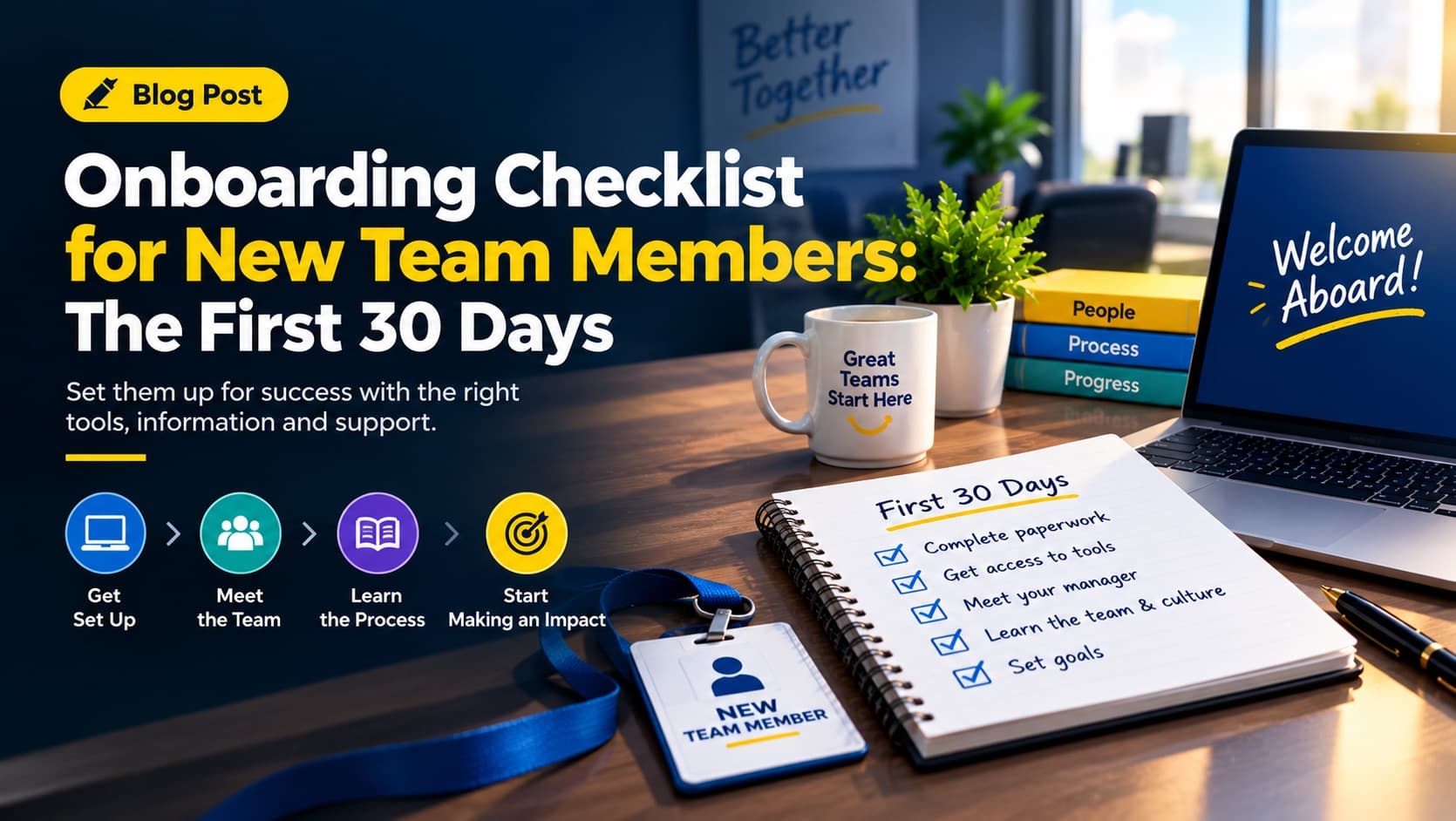
A new hire decides surprisingly fast whether they made the right choice. By the end of the first month, most people have a clear feeling about the company, their manager, and whether they can succeed in the role. That is why a clear onboarding checklist for new team members is one of the most useful tools a manager, founder, or HR lead can have.
This guide walks through the first 30 days step by step. It covers pre-boarding, day one, each week of the new hire onboarding process, and the 30-day check-in. You will also find a sample 30-60-90 day plan, a remote onboarding section, role-based variations, two real-world case studies, and answers to the questions managers ask most often. Use it as a ready-to-adapt 30-day onboarding plan, whether you are hiring your first employee or your fiftieth.
The Onboarding Gap: What the Data Says
Most companies believe they onboard well. Their employees often disagree.
- Only 12% of employees rate onboarding well. Just 12% of US employees say their company does a good job of onboarding, according to Gallup's onboarding research.
- Manager involvement changes the outcome. Gallup found that when the manager takes an active role in onboarding, employees are 3.4 times as likely to feel their onboarding process was successful.
- Ramp-up takes longer than a month. In Gallup's experience it takes 12 or more months for most people to get up to speed in most jobs, so the first 30 days are a foundation, not the finish line.
The takeaway is simple: a written, repeatable plan and an involved manager are the two biggest levers you control.
Why a Structured Onboarding Checklist Matters
Onboarding is more than paperwork and a login. It is the period when a new employee learns how your team works, what good looks like, and where they fit. A checklist keeps that process consistent, so a new hire's experience does not depend on how busy their manager happens to be that week.
A well-built employee onboarding process helps in four practical ways:
- Faster ramp-up. New hires spend less time guessing and more time doing useful work.
- Fewer avoidable mistakes. Clear expectations and documented processes reduce errors that come from missing context.
- Stronger retention. People who feel welcomed and supported early are more likely to stay and grow.
- Less strain on the team. When the plan is written down, existing team members are not answering the same questions repeatedly.
The goal is not to create a rigid script. It is to make sure nothing important is forgotten and that the new person always knows what comes next.
If you are also trying to hire faster, strong onboarding pairs well with a tighter hiring process. See our guide on how to reduce time to hire.
The 30-Day Onboarding Checklist at a Glance
| Stage | Main goal | Must-do items |
|---|---|---|
| Pre-boarding | Remove day-one friction | Welcome message, paperwork, equipment, accounts, buddy |
| Day one | Feel welcome and oriented | Team intro, 1:1 with manager, policies, end-of-day check-in |
| Week 1 | Build context | Role description, org overview, small first task |
| Week 2 | Learn the work | Tool training, job shadowing, how success is measured |
| Week 3 | Take ownership | Own a small project, cross-team intros, suggest one improvement |
| Week 4 | Review and plan | 30-day review, onboarding feedback, next 60 days |
Swipe the table to see all columns
Before Day One: The Pre-Boarding Checklist
Onboarding starts the moment an offer is accepted. The gap between acceptance and the first day is a good chance to build confidence and remove day-one friction. This stage is often called pre-boarding.
- Send a warm welcome message from the hiring manager with the start date, time, location or video link, and who to ask for on arrival.
- Complete employment paperwork, contracts, and any required tax or compliance forms before the first day so day one is not spent on forms.
- Order and prepare equipment: laptop, phone, access cards, and any software licenses.
- Create accounts for email, chat, project management tools, and shared drives, and test that the logins work.
- Share a simple first-week schedule so the new hire knows what to expect.
- Assign an onboarding buddy, a peer who can answer everyday questions the manager does not have time for.
- Let the team know who is joining, what they will do, and when they start.
A useful habit is to ask the new hire if they have any accessibility needs, dietary preferences for a team lunch, or questions before they start. Small gestures like this show that you were expecting them.
Short on HR capacity?
Screening, paperwork, and onboarding logistics are exactly what a recruitment, screening, and onboarding staffing partner can take off your plate.
Day One: Welcome, Orientation, and Clarity
The first day should leave the new employee feeling welcome and oriented, not overwhelmed. Resist the urge to schedule every hour with training sessions. A calm, friendly first day is more valuable than a packed one.
- Greet the new hire personally, whether in person or on video, and introduce them to the team.
- Walk through the workspace, or the virtual workspace, including where to find tools, documents, and help.
- Confirm that all equipment and accounts work.
- Hold a short one-on-one meeting with the manager to explain the plan for the first 30 days.
- Introduce the onboarding buddy and schedule a daily or twice-weekly check-in.
- Share the company mission, values, and a short history of how the business got here.
- Review the key policies: working hours, communication norms, time off, and security basics.
- Share lunch or a casual coffee chat with the team.
- End the day with a quick check-in: How did it go? What questions came up?
Day one is also the right time to explain how the team communicates. Which channel is for urgent issues? When are meetings held? How quickly are replies expected? These unwritten rules cause a lot of early confusion when nobody states them.
Week One: Build Context and Relationships
The first week is about understanding the bigger picture. Your new team member should learn what the company does, who its customers are, how the team is organized, and how their role contributes.
- Provide a written role description with clear responsibilities for the first 30, 60, and 90 days.
- Share organizational information: who reports to whom, who to ask for what.
- Schedule short introductions with the people they will work with most often.
- Explain the main products or services and walk through a typical customer journey.
- Give access to core documents such as process guides, style guides, templates, and past examples of good work.
- Complete required training, such as security awareness, safety, or compliance courses.
- Assign a small, low-risk first task so the new hire can start contributing early.
- Hold a week-one feedback conversation at the end of the week.
The small first task matters more than it may seem. Finishing something real in the first week builds confidence and gives the new hire a concrete way to learn your tools and standards.
Manager tip
Ask the new hire to write down questions as they go, then review them together. This helps you spot gaps in your documentation and shows the new person that questions are welcome.
Week Two: Start Learning the Work
By week two, the new hire should shift from observing to participating. The focus is on role-specific skills, tools, and workflows.
- Provide hands-on training for the main tools and systems the role uses.
- Pair the new hire with an experienced colleague for job shadowing on real tasks.
- Assign a slightly larger task with a clear outcome and a deadline.
- Explain how work is prioritized, reviewed, and approved.
- Review how success is measured in the role, including key goals or metrics.
- Introduce the broader team through a short presentation or an informal Q&A.
- Hold a regular one-on-one with the manager to discuss progress and blockers.
This is a good time to explain how feedback works in your team. Do people give feedback in writing or in meetings? Is it formal or informal? When new hires understand the feedback process, they are less anxious about it.
Training on repetitive tools such as CRMs is often where new hires lose the most time. If your team struggles with data hygiene, see how we approach CRM updates and data entry.
Week Three: Take On More Ownership
In week three, the new employee should begin handling parts of the job independently, with support available when needed. The aim is a gradual move from guided work to ownership.
- Assign a real project or workstream that the new hire can own with light supervision.
- Encourage them to attend relevant meetings and contribute ideas.
- Review early work together and give specific, constructive feedback.
- Introduce cross-functional colleagues, such as sales, finance, support, or operations, so the new hire sees how teams connect.
- Ask the new hire to suggest one improvement to a process, document, or workflow based on their fresh perspective.
- Revisit the 30-60-90 day goals and adjust if needed.
New employees often notice problems that long-time team members no longer see. Asking for their observations makes them feel valued and can surface useful improvements. If those observations point to bigger process gaps, an operations audit is a structured way to find and fix them.
Week Four: Review, Reflect, and Plan Ahead
The last week of the first 30 days is for reflection and forward planning. It should include a formal check-in that goes both ways: the manager shares feedback, and the new hire shares their experience of onboarding.
- Hold a structured 30-day review meeting covering strengths, areas to develop, and progress against goals.
- Ask for honest feedback on the onboarding experience: what helped, what was confusing, and what was missing.
- Confirm that the new hire understands their priorities for the next 60 days.
- Discuss learning and growth goals, including training, mentoring, or skill development.
- Check that all tools, permissions, and access are correct for the role.
- Recognize early wins, even small ones, publicly or privately.
- Update the onboarding checklist based on what you learned.
The last item is easy to skip, but it is what turns onboarding from a one-time event into a process that improves with every hire.
Sample Questions for the 30-Day Check-In
These open-ended questions tend to produce useful answers:
- What has gone better than you expected so far?
- What has been harder than you expected?
- Do you feel clear about what success looks like in your role?
- Is there any information or training you wish you had received earlier?
- How can I support you better as your manager?
Listen first. If a new hire shares something critical, thank them and act on it where you can. That builds trust more than any welcome gift.
Sample 30-60-90 Day Plan (Example)
The 30-60-90 day plan gives a new hire written goals so they never have to guess what success looks like. Here is an example for a customer success coordinator. Adapt the details to your own roles.
| Period | Focus | Example goals |
|---|---|---|
| Days 1 to 30: Learn | Understand the company, customers, tools, and team | Complete all required training; shadow 10 customer calls; handle 5 low-risk accounts with a buddy's review; suggest one process improvement |
| Days 31 to 60: Contribute | Work independently on core tasks | Own a portfolio of accounts; run weekly check-ins with clients; meet response-time targets; document one recurring workflow |
| Days 61 to 90: Own | Deliver results and look ahead | Hit agreed performance metrics; lead a client review; propose one initiative for the next quarter; agree growth goals with the manager |
Swipe the table to see all columns
Revisit the plan at the end of each period and adjust it together. A plan that changes because the new hire learned something is a good sign, not a failure.
Remote Employee Onboarding Checklist
If your new team member works remotely, the same 30 days apply, but a few steps need extra attention. Remote employees cannot pick up culture by walking past a desk, so you need to be intentional about connection and clarity.
- Ship equipment early and confirm that it arrives and works before day one.
- Provide a clear guide to communication tools, time zones, and expected response times.
- Schedule short video introductions with each key colleague in the first two weeks.
- Hold more frequent check-ins, such as a brief daily touchpoint during week one.
- Write down processes instead of relying on hallway knowledge.
- Invite the new hire to virtual team events, and consider a virtual coffee with the buddy.
- Explain how work is shared and tracked so progress is visible without constant messaging.
The most common remote onboarding problem is isolation. A new hire who feels disconnected rarely says so. Frequent, friendly check-ins help you catch that early.
In-Office vs. Remote Onboarding at a Glance
| Area | In-office | Remote |
|---|---|---|
| Equipment | Ready at the desk on day one | Shipped and tested before day one |
| Culture | Absorbed through daily presence | Built through intentional video chats and written values |
| Knowledge | Shared in person | Documented in a handbook or wiki |
| Check-ins | Natural, informal | Scheduled, more frequent in week one |
| Biggest risk | Overloading day one | Isolation and unclear expectations |
Swipe the table to see all columns
Role-Based Onboarding: Adjust the Checklist to the Job
The core 30 days stay the same, but the content of weeks two and three should match the role:
- Sales: product and pricing training, CRM setup, call shadowing, and a first-lead plan.
- Developers and technical roles: environment setup, code walkthroughs, a first small ticket or pull request, and a review of engineering standards.
- Customer support: knowledge-base tour, ticket shadowing, tone and escalation guidelines, and a first supervised response.
- Operations and back-office: process documentation, tool access, quality checks, and a small workflow to own. Teams that rely on back-office support services often find that written procedures make onboarding much easier.
- Finance and procurement: approval limits, vendor and system access, and compliance training. Our guide to technology procurement challenges shows what new procurement hires should understand early.
Onboarding Several New Hires at Once
Growing teams often start several people in the same week. A few adjustments keep quality high:
- Run a shared day-one orientation for company-wide topics, then split into role-specific sessions.
- Give each hire their own buddy so nobody gets a diluted experience.
- Use one master checklist and track each person's progress in a shared sheet or project board.
- Build a cohort chat so new hires can support each other.
- Block manager time for one-on-ones in advance, because that is the first thing to slip when a team is busy.
Case Studies
Case Study 1: Google and the Five-Item Manager Checklist
The challenge. Google's People Operations team wanted to help new hires (known as "Nooglers") become productive faster. Laszlo Bock, Google's former SVP of People Operations, describes the experiment in his book Work Rules!
What they did. Instead of building a large new program, the team sent managers a short email the day before or the Sunday before a new hire started. It listed a handful of simple actions, including matching the new hire with a peer buddy, helping them build a social network, and setting up a monthly onboarding check-in for the first six months. A follow-up reminder arrived two weeks later.
The result. According to published summaries of the experiment, new hires whose managers acted on the checklist became fully effective about 25% faster than their peers. Bock describes this in his talks as proof that small nudges and checklists make a difference, even when the list is simple.
What you can copy. You do not need Google's budget. Write a short manager checklist, send it before the start date, and follow up. The buddy, the social connections, and the regular check-ins are all in the checklist you just read.
Case Study 2: GitLab's All-Remote Onboarding Issue
The challenge. GitLab is an all-remote company, so new team members cannot learn by sitting near colleagues. Onboarding had to work across time zones without relying on meetings.
What they did. Every new hire gets a standardized onboarding issue template that lists tasks for the new team member, their manager, and the People team. It is designed to be self-driven and as asynchronous as possible, with a 30-day completion window. GitLab also assigns each hire an onboarding buddy, matched where possible by time zone, and the buddy is encouraged to schedule a call early. New team members complete an onboarding survey after their first 30 days, and the People team reviews buddy feedback quarterly. The whole approach is supported by a public handbook, described in GitLab's remote onboarding guide.
What you can copy. A single written checklist with clear owners, a named buddy, and a 30-day feedback survey. These are the same pillars as this guide, and they work for teams of any size, remote or not.
Common Onboarding Mistakes to Avoid
Even well-meaning teams fall into the same traps. Watch for these:
- Information overload. Delivering everything in the first two days makes it hard to remember anything. Spread learning across the month.
- No clear goals. If a new hire does not know what success looks like, they will guess. Provide written 30-60-90 day goals.
- Leaving the new hire alone. A manager who is too busy to meet is a common reason new employees feel lost. Protect time for check-ins.
- Skipping the buddy system. A peer contact gives the new person a safe place to ask basic questions.
- Treating onboarding as only HR paperwork. Forms matter, but relationships, context, and confidence matter more.
- Never asking for feedback. Without it, your process cannot improve.
- Ending onboarding too early. The first 30 days are a foundation, not the finish line. Continue support through at least the first 90 days.
How to Measure Onboarding Success
You do not need complex software to evaluate your new employee onboarding checklist. A few simple measures can tell you whether it works:
- Time to first contribution. How long until the new hire completes a meaningful task?
- Confidence and clarity. Ask the new hire to rate how clear they feel about their role and priorities.
- Manager feedback. Does the manager feel the new hire is progressing as expected?
- Onboarding feedback. Collect comments on what worked and what did not. Short pulse surveys during onboarding catch problems early.
- Retention over time. Track whether new hires stay and grow in the first year.
Review these results after each hire and update the checklist. Over time, your process becomes tailored to your team's actual needs.
Final Thoughts
A strong onboarding experience does not require a large budget or a dedicated HR department. It requires preparation, clear communication, and genuine attention to the person joining your team. Use this onboarding checklist for new team members as your starting point, adapt it to your business, and refine it after every hire.
If you remember only three things, make them these: prepare before day one, give the new hire clear goals and a friendly point of contact, and ask for feedback at the end of the month. Do those well, and the first 30 days will set a new team member up for a productive, confident start.
Need Help Building Your Onboarding Process?
If you are hiring and want help with sourcing, screening, and onboarding, The Black Skull's HR and staffing services can support you at each stage. Want to lighten the admin load around new hires? Explore our back-office support services, or get in touch to talk through your needs. You can also send us an inquiry or read more on our blog.
Frequently Asked Questions
What should be included in an onboarding checklist for new employees?
A good checklist covers pre-boarding tasks, day-one orientation, role and team introductions, tool training, goal setting, regular check-ins, and a 30-day review. It should also include practical items such as equipment, accounts, and policy reviews.
How long should the onboarding process last?
The core onboarding checklist usually covers the first 30 days, but many teams extend structured support to 60 or 90 days. Complex roles may need longer, and Gallup notes that full ramp-up often takes around 12 months.
How do you onboard a new employee in 30 days?
Break the month into stages. Use week one for orientation and context, week two for learning the work, week three for taking on ownership, and week four for review and planning. Keep regular one-on-one meetings throughout.
What is the difference between orientation and onboarding?
Orientation is a short event, usually in the first days, that covers basics such as policies, introductions, and logistics. Onboarding is the longer process of helping a new hire become productive, connected, and confident in the role.
How is remote onboarding different?
Remote onboarding needs more written documentation, more frequent check-ins, earlier equipment delivery, and deliberate relationship building, since there are no casual office interactions.
Who is responsible for onboarding a new team member?
It is shared. HR or operations usually handles paperwork and compliance, the manager sets goals and gives feedback, and a buddy or peer supports everyday questions. Clear ownership of each task prevents gaps.
Do small businesses need a formal onboarding checklist?
Yes. In fact, small teams often benefit most because each hire has a big impact and there is less spare time to fix mistakes. A simple one-page checklist is enough to start.
Should I use a template?
Yes. Copy the checklists in this guide into a shared document or project board, assign an owner to every task, and edit it after each hire. A template you improve is better than a perfect one you never finish.
Hiring Soon and Short on Time?
We support sourcing, screening and onboarding coordination, and take the admin around new hires off your team's plate.
Contact Us Today