
Key Takeaways
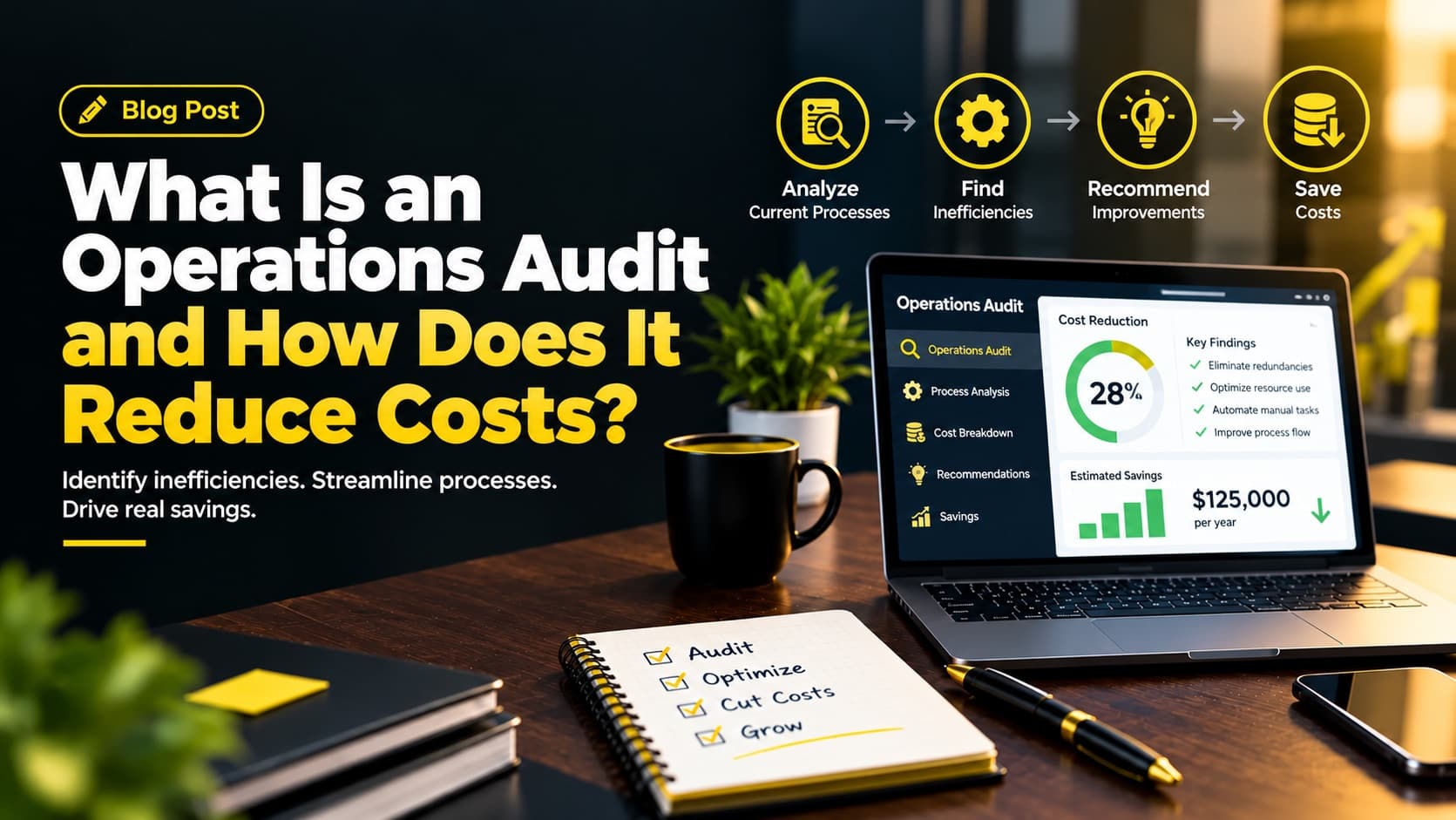
- An operations audit (also called an operational audit) is a structured review of your processes, vendors, software, and staffing that finds where money and time are leaking out.
- It differs from a financial audit (are the books accurate?) and a compliance audit (are we following the rules?). It asks whether the business runs efficiently and cost-effectively.
- Savings come from removing rework, renegotiating vendor contracts, cutting unused software, fixing hiring bottlenecks, and moving routine work off expensive time.
- A sound audit follows seven steps and ends with a ranked action plan that has an owner and a deadline for every fix.
- Both cost and savings depend on scope, so agree on how you will measure results before the audit starts.
An operations audit is a structured review of how your business actually runs day to day: the processes your team follows, the vendors you pay, the software you subscribe to, and the staffing that holds it all together. Its purpose is simple. It finds where money, time, and effort are leaking out of the business, then ranks the fixes by impact so you know what to tackle first.
If your operating costs keep creeping up while revenue stays flat, or your team spends more time chasing approvals and correcting errors than serving customers, an operations audit replaces guesswork with evidence. In this guide you will learn what an operations audit covers, how the process works step by step, where the savings come from, what it costs, and how to decide who should run it.
What Is an Operations Audit?
An operations audit is an independent, systematic review of how a company's day-to-day operations actually perform. Professionals call it an operational audit, and it is one type of internal audit engagement, carried out under the Institute of Internal Auditors' Global Internal Audit Standards. Unlike a financial audit, it does not test whether the numbers are accurate. It looks at four things, commonly called the 4Es: efficiency, effectiveness, economy, and ethics.
- Efficiency: are we doing things right, using the least time and money to get the result?
- Effectiveness: are we doing the right things, and do our results match our goals?
- Economy: are we paying a fair price for the vendors, tools, and services we use?
- Ethics: are people acting within our policies and values as they do the work?
Instead of checking whether your books are accurate, an operations audit asks questions such as:
- Are our processes efficient, or are they slow because of habit?
- Are the right people doing the right work?
- Where do errors, delays, and rework keep happening?
- Do our results match what we say our goals are?
The output is not a pile of observations. A good operations audit ends with a prioritized list of findings, an estimate of the value of each fix, and a realistic plan for acting on them.
Operations Audit vs. Financial Audit vs. Compliance Audit
These three terms are often confused, so it helps to separate them.
| Type of audit | Main question | Typical output |
|---|---|---|
| Operations audit | Is the business running efficiently and cost-effectively? | Improvement and savings opportunities |
| Financial audit | Are the financial statements accurate and fairly presented? | Audit opinion on the financials |
| Compliance audit | Are we following the laws, regulations, and policies that apply to us? | Gaps and corrective actions |
Swipe the table to see all columns
The three overlap. An operations audit may uncover a compliance risk, and it often relies on financial data. But only the operations audit is designed to improve how the work gets done and what it costs.
Operations Audit vs. Process Improvement Projects
A process improvement project usually starts with a known problem, such as slow invoice approvals, and fixes it. An operations audit starts earlier. It looks across the business to discover which problems are costing you the most, so that your improvement effort goes where it matters. Think of the audit as the diagnosis and process improvement as the treatment.
Objectives and Benefits of an Operational Audit
The objective of an operational audit is to give leaders a clear, evidence-based picture of how well operations support the business's goals. When it is done well, the benefits go beyond one-off savings:
- Lower operating costs: waste, duplication, and overpriced contracts become visible and fixable.
- Faster, more reliable processes: shorter cycle times and fewer handoffs mean work reaches customers sooner.
- Better use of people: skilled staff spend less time on routine tasks and more on work that grows the business.
- Stronger controls: clearer approval limits and exception handling reduce errors and risk.
- Better decisions: reliable reports and data replace opinions and guesses.
- A measurable baseline: you can prove later whether the changes worked.
Signs Your Business Needs an Operations Audit
You do not need to wait for a crisis. Still, certain signals suggest the time has come:
- Costs are rising faster than revenue. Expenses grow every quarter, but nobody can explain exactly why.
- Work depends on a few people. If one person leaves, a whole process stalls because nothing is documented.
- Manual work is everywhere. Staff re-enter the same data in several systems, or move information between spreadsheets and email.
- Vendor and software bills keep growing. Contracts auto-renew, subscriptions overlap, and nobody owns the full list.
- Hiring feels slow and expensive. Roles stay open for weeks, and new hires take too long to become productive.
- You are scaling. Processes that worked for ten people often break at fifty.
- Errors reach customers. Wrong invoices, missed follow-ups, and delayed deliveries are symptoms of weak processes behind the scenes.
If three or more of these sound familiar, an audit will probably pay for itself.
What Does an Operations Audit Review?
The scope depends on your business, but most audits examine the following areas.
Core Processes and Workflows
The auditor maps how work actually flows, from the moment a customer request or order arrives to the moment it is delivered and paid for. The key word is actually. Written procedures (SOPs) and real behavior often differ, and the gap between them is where waste hides. Common findings include unnecessary approval steps, handoffs that add delay, and tasks done twice because two teams do not trust each other's data.
Vendors and Procurement
Vendor spending is one of the most reliable sources of savings because it is easy to ignore. An audit lists every supplier, compares contract terms against current needs, and checks whether you have ever compared alternatives. A consistent comparison method makes a real difference, which is why a vendor quote comparison checklist is a useful tool to have before renewals come due.
Technology and Software
The audit inventories your tools and asks whether each one is used, needed, and priced correctly. Duplicate platforms, unused licenses, and over-provisioned plans are common. Technology purchases also carry hidden costs in setup, training, and integration. Our guides to technology procurement and business costs and technology procurement challenges explain where those costs come from.
Staffing, Hiring, and HR Processes
People are usually the largest operating expense, so the audit looks at how roles are structured, how workload is distributed, and how hiring and onboarding work. Slow or disorganized hiring has a direct cost. See how to reduce time to hire and what a recruitment, screening, and onboarding partner handles.
Back-Office Functions
Data entry, invoicing, scheduling, CRM maintenance, and reporting rarely get attention until they break. They are also where manual effort accumulates. An audit measures how many hours these tasks consume and whether they should be streamlined, automated, or handled by a dedicated support team. For more, see our overview of back-office support services and why CRM updates and data entry matter for sales and service teams.
Data, Reporting, and Controls
Finally, the audit checks whether leaders have the information they need to make decisions. If reports are late, inconsistent, or built by hand, decisions are slower and riskier. It also reviews basic internal controls, such as who can approve spending and how exceptions are handled.
How an Operations Audit Helps You Reduce Operating Costs
Reducing operating costs through an audit rarely comes from one dramatic move. It comes from a series of specific, well-evidenced changes. The audit is the discovery stage: it finds and sizes the opportunities. Our companion guide on operational cost reduction covers the action stage, meaning which cost categories to cut first and how. Here are the main sources of savings the audit uncovers.
1. Removing Duplicate Work and Rework
Every time a task is done twice, or an error has to be corrected, you pay for the same output more than once. By mapping workflows, an audit exposes these loops. Fixing the root cause, such as unclear instructions or a missing field in a form, eliminates the repeated cost permanently rather than just treating the symptom.
2. Renegotiating or Replacing Vendor Contracts
Many contracts were signed under old assumptions: lower volumes, different needs, or no competing options. The audit gives you the facts to renegotiate. Knowing your actual usage and having market comparisons in hand strengthens your position considerably. Our guide on how to negotiate with technology vendors walks through this approach in practice.
3. Cutting Unused and Overlapping Software
Subscriptions pile up quietly. A tool bought for one project stays active after the project ends. Two departments pay for different tools that do the same job. Cancelling or consolidating these is often the fastest win because it requires no change to how people work, only a decision.
4. Lowering Hiring and Turnover Costs
A vacant role costs productivity, and a bad hire costs even more. When the audit finds bottlenecks in screening, interviewing, or onboarding, fixing them shortens vacancies and improves the quality of hires. Better onboarding also helps new employees stay.
5. Shifting Low-Value Work Off Expensive Time
If your most experienced people spend part of every week on data entry or admin, you are paying senior rates for routine work. The audit quantifies this and helps you decide what to automate, delegate, or assign to a dedicated back-office support team.
6. Reducing Errors, Delays, and Their Downstream Costs
Mistakes are expensive in ways that do not always show up on a single line of the budget: credits to customers, late fees, lost repeat business, and staff time spent on apologies and fixes. Strengthening processes and controls reduces these hidden costs.
The Operations Audit Process: Step by Step
The details vary, but a sound operations audit process follows a clear sequence.
Define Scope and Goals
Start by deciding what you want the audit to answer. "Reduce operating costs by finding waste in procurement and back-office work" is a usable goal. "Look at everything" is not. Agree on the departments, time period, and success measures (KPIs) upfront, and make sure leadership supports the effort, because audits often cross team boundaries.
Collect Data and Documents
Gather the evidence: process documents, org charts, vendor contracts, software invoices, expense reports, headcount and payroll summaries, and any performance reports. Whenever possible, work from real transaction data rather than from descriptions of what people believe happens.
Observe and Interview
Talk to the people who do the work, not only to their managers. Frontline staff know where the workarounds are and why they exist. Ask open questions such as "What slows you down?" and "What do you do that you think is unnecessary?" Observing work directly, even briefly, often reveals what interviews miss.
Map and Measure Current Processes
Document the real workflow for each in-scope process and attach numbers to it: how long each step takes, how many people touch it, how often errors occur, and what it costs. Metrics turn opinions into priorities. Useful measures include cycle time, error rate, cost per transaction, and hours spent on manual tasks.
Analyze Findings and Quantify Opportunities
Compare what you found against your goals and against reasonable benchmarks, such as your own past performance, internal best practices, or industry norms. For each finding, estimate the annual cost of the problem, the cost and effort to fix it, and the risk involved (a simple return-on-investment view). A finding that saves a little and takes a year to implement ranks below one that saves a lot in a month.
Report and Build an Action Plan
The final report should be short enough to be read and specific enough to act on. It should include prioritized recommendations, an owner for each, a timeline, and the expected result. Present quick wins separately from larger projects so momentum builds early.
Implement and Follow Up
An audit that does not change anything has no value. Schedule check-ins, track the metrics you established in Step 4, and confirm that savings are real. Many businesses repeat a lighter version of the audit annually.
A Practical Operations Audit Checklist
Use this operations audit checklist as a starting point. Adapt it to your industry and size.
Processes
- Are the top five to ten processes documented, and do the documents match reality?
- Where do approvals, handoffs, or reviews add delay without adding value?
- Which tasks are repeated, corrected, or redone most often?
Vendors and Procurement
- Do we have a complete list of vendors, with contract dates, terms, and annual spend?
- When were our largest contracts last compared against alternatives?
- Who is responsible for each renewal, and when is the notice deadline?
Technology
- Which software tools do we pay for, and how many licenses are actually in use?
- Do any tools overlap in function?
- Do our systems share data, or do people retype it?
People and Hiring
- How long does it take to fill a typical role, and where does the process stall?
- Is onboarding consistent, and how quickly do new hires become productive?
- Are skilled employees spending time on routine tasks?
Back Office and Data
- How many hours per week go to data entry, invoicing, and reporting?
- Is our customer and sales data current and accurate?
- Do leaders receive timely, reliable reports?
Controls and Risk
- Who can approve spending, and are limits enforced?
- What happens when a process fails, and how do we find out?
Want a second set of eyes on your answers?
If several of these questions are hard to answer, that is usually a sign an audit will find savings. Our team can walk through your processes, vendors, and back-office workload with you. Contact our team to discuss an operations audit for your business.
What Does an Operations Audit Report Include?
The report is where the audit turns into action. A useful operations audit report is short, evidence-based, and organized so that a busy leader can decide what to do next. It typically contains:
- Executive summary: the biggest findings, the total estimated opportunity, and the top three actions.
- Scope and method: what was reviewed, which period, and what data and interviews the findings rest on.
- Baseline metrics: cycle times, error rates, costs per transaction, and hours spent on manual work, so progress can be measured later.
- Findings ranked by impact: each with its evidence, annual cost, and the effort needed to fix it.
- Recommendations and action plan: an owner, a timeline, and an expected result for every item, with quick wins separated from larger projects.
- Follow-up plan: which metrics to track and when to review them.
A simple finding template keeps the report consistent. The row below is an illustration of the format, not a client result:
| Finding | Evidence | Annual cost | Recommended fix | Effort | Owner |
|---|---|---|---|---|---|
| Overlapping project tools | 3 tools, 2 with under 20% of licenses in use | Example: $4,200 | Cancel two tools, keep one | Low | Operations lead |
Swipe the table to see all columns
Case Study
To make this concrete, here is a hypothetical scenario. The figures are to show how the thinking works, not results from a real client.
Imagine a 40-person services company whose monthly costs have been rising for a year. An operations audit reviews its vendor list and finds three software tools with overlapping features, two of which are barely used (example cost: about $4,200 a year). It finds a telecom contract that auto-renewed at an old rate even though headcount had dropped. It maps the invoicing process and discovers that every invoice is entered into two systems by hand, adding roughly 12 hours of work each week and causing frequent mismatches. It also notices that open roles take about 45 days to fill because candidate screening is handled ad hoc.
None of these findings is exotic. Together, though, they point to savings in software, vendor spend, staff time, and hiring delays. The recommended fixes are specific: cancel two tools, renegotiate one contract, integrate invoicing, and standardize screening.
How Much Can an Operations Audit Save?
Honest answer: it depends on your starting point. A business that has never reviewed its operations will usually find more opportunity than one that reviews them every year. Savings also vary by industry, size, and how willing the organization is to act on the findings.
Be cautious of anyone who promises a fixed percentage before looking at your business. A more reliable way to think about it is in three parts:
- Hard savings: reductions you can see on an invoice or payroll report, such as cancelled subscriptions and lower contract rates.
- Productivity gains: hours freed up from manual work, which become savings only if they are redirected to higher-value work or avoid new hires.
- Risk reduction: fewer errors, stronger controls, and less dependence on individuals.
Before the audit, agree on how you will measure each of these. Otherwise, it is hard to prove the return afterward.
How Much Does an Operations Audit Cost?
There is no standard price, and you should be wary of any figure quoted before the scope is known. Four factors drive the cost:
- Scope: one function, such as vendors and software, costs far less to review than the whole company.
- Size and complexity: more staff, locations, and systems mean more processes to map.
- Data readiness: organized contracts, invoices, and process documents speed the work up. Missing documents slow it down.
- Who performs it: an in-house audit costs staff time rather than fees, though that time still has a price. A specialist engagement is usually quoted as a fixed fee for a defined scope, a day or hourly rate, or a retainer for ongoing reviews.
A practical way to judge the price is to ask for a written scope with deliverables, then compare the fee with the savings you expect in your highest-spend areas. A narrow audit of vendors and software often pays back fastest because the savings show up directly on invoices. Whoever you work with, ask what will be reviewed, what data you need to provide, what the final report contains, and how results will be measured.
Who Performs an Operations Audit: In-House Team or Specialist?
Both approaches work, and the right choice depends on your situation.
An in-house audit makes sense when the scope is narrow, you have someone with the time and independence to do it, and the processes are simple enough to evaluate without special expertise.
An independent specialist makes sense when the audit crosses departments, internal politics might bias results, nobody has the capacity, or you want an experienced view of what is normal and what is wasteful. A specialist also finds it easier to ask why something is done a certain way.
If you want that support, our operations cost reduction services are built for this kind of review, and we can connect it with related help in technology procurement, back-office support, and HR and staffing.
Common Operations Audit Mistakes to Avoid
- Starting without a clear goal. An unfocused audit produces unfocused results.
- Auditing only what managers say. Interviews without data, or data without interviews, give an incomplete picture.
- Treating it as a blame exercise. If people fear the audit, they hide problems. Frame it as a way to make their work easier.
- Chasing small items first. Rank by impact and effort so the big opportunities do not wait behind trivial ones.
- Stopping at the report. Findings without owners and deadlines tend to be forgotten.
- Cutting too deep. Savings that damage service quality or employee morale cost more in the long run.
What to Do in the First 90 Days After an Audit
Days 1 to 30: Capture quick wins
Cancel unused subscriptions, flag upcoming contract renewals, and fix obvious process errors. These actions show results early and build trust in the effort.
Days 31 to 60: Start the larger changes
Begin vendor renegotiations or replacements, document and standardize key processes, and launch any automation or hiring-process improvements.
Days 61 to 90: Measure and adjust
Compare current metrics against your baseline, confirm that savings are real, and decide what to tackle next. Schedule the next review so the benefits are not lost over time.
Final Thoughts: Make Costs Visible, Then Make Decisions
An operations audit does not cut costs by itself. What it does is make your costs visible, tie them to specific processes, vendors, and decisions, and give you the evidence to act with confidence. The businesses that benefit most are the ones that pick a clear goal, listen to the people doing the work, rank findings by impact, and follow through.
Ready to see where your operating costs are leaking? Contact our team or send an inquiry to discuss what an operations audit could look like for your business.
Frequently Asked Questions
How long does an operations audit take?
A focused audit of one or two functions can take a few weeks. A company-wide review of a larger organization can take a few months. Data availability and how quickly people can be interviewed are the biggest factors.
How often should a business perform an operations audit?
A full audit every two to three years is common, with lighter annual check-ins on high-spend areas such as vendors and software. Run one sooner if you are growing quickly, merging with another business, or seeing unexplained cost increases.
Is an operations audit only for large companies?
No. Small and mid-sized businesses often benefit the most, because a single renegotiated contract or removed bottleneck is a larger share of their total spend. The audit simply needs to be sized to fit the business.
What documents should I prepare?
Have your vendor contracts, software and subscription invoices, process documents, org chart, recent expense and payroll summaries, and any performance reports ready. Missing documents are not a barrier. The audit will often reveal that they should exist.
Will an operations audit disrupt my team?
A well-run audit takes limited time from your staff, mostly for interviews and short observations. Explaining the purpose in advance helps people see it as support, not scrutiny.
What is the difference between an operations audit and operational cost reduction?
The audit is the discovery stage. It finds and quantifies the opportunities. Operational cost reduction is the action stage, where you carry out the changes.
How much does an operations audit cost?
It depends on scope, company size, data readiness, and who performs the audit. Ask for a written scope and deliverables, then compare the fee with the savings you expect in your highest-spend areas.
What does an operations audit report include?
An executive summary, scope and method, baseline metrics, findings ranked by impact, recommendations with owners and timelines, and a follow-up plan for tracking results.
Who performs an operations audit?
It can be an internal team member with the time and independence to do it, or an independent specialist with operations experience. Broad audits that cross departments usually benefit from a specialist's neutral view.
Is an operational audit the same as an operations audit?
Yes. The terms are used interchangeably. "Operational audit" is the term most common in professional internal auditing, while "operations audit" is more common in everyday business language.
Not Sure Where Your Costs Are Leaking?
We review processes, vendors, software and back-office workload, then hand you a ranked plan with an owner and a deadline against every fix.
Contact Us Today