
If your day is split between chasing late rent, hunting for a lease clause and answering the third repair-update call before lunch, the problem is rarely effort. It is how the work is organized. To streamline property management operations, you need to connect leases, payments, tenants, maintenance and vendors instead of fixing each one alone. This guide gives you ten practical steps, a worked example and a 12-week plan to follow.
Quick answer
The fastest way to streamline property management operations is to map one workflow, give every task one owner, store lease data in one consistent format, and track rent, repairs and vendors in one visible system. Review the numbers weekly.
What Property Management Operations Actually Include
Property management operations are the recurring activities that keep a building occupied, paid for and in good repair. Each one feeds the next, so property management efficiency improves fastest when you fix the connections rather than a single task.
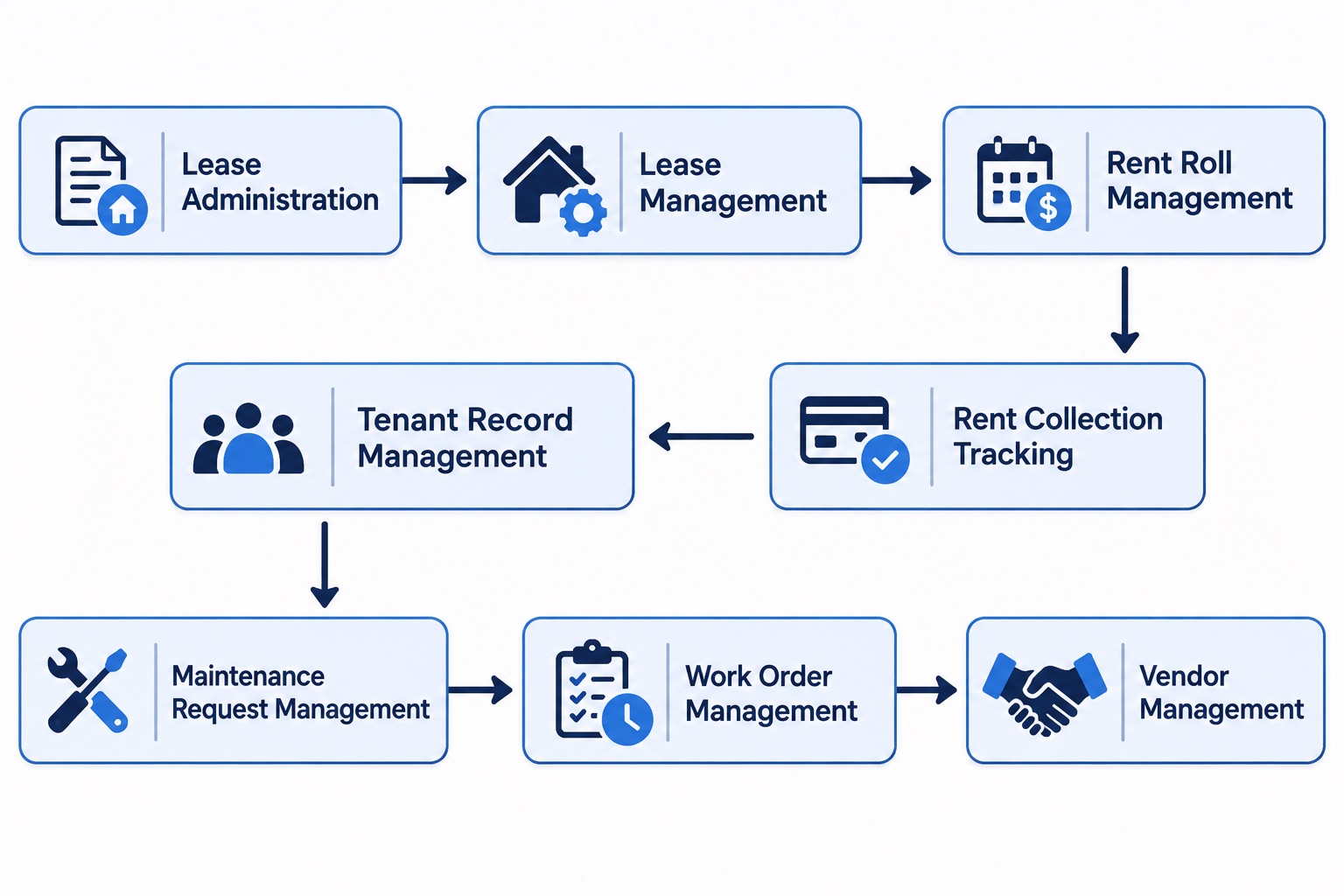
A lease start date sets the rent roll entry, the rent roll sets the collection schedule, and an unpaid balance changes how a renewal is handled. The ten steps below follow this chain. For a deeper look at how workflows connect, see our guide to workflow optimization.
10 Ways to Streamline Property Management Operations
Map Your Property Management Workflow Before You Change It
Most overload comes from invisible steps. Pick one routine, such as move-in, and write down every action from signed lease to handed-over keys. Note who does it, which tool they use and where it waits. You will usually find duplicate data entry, unclear hand-offs and tasks only one person knows how to do.
This exercise is the base of administrative process optimization. A mapped property management workflow shows which steps to remove, which to standardize and which to hand to a dedicated owner. Repeat it for move-out, renewals, rent collection and repairs. If you want a structured version of this exercise, read what an operations audit is and how it works.
Separate Front-Office Contact From Back-Office Support
Leasing agents and on-site managers deal with people. Data entry, filing, ledger updates, reminders and reporting need their own owner and schedule. Property management back-office support gathers these administrative tasks in one place, so tenant conversations are not constantly broken by paperwork.
Whether that support sits with a named team member or a specialist business support provider, the principle is the same: one accountable person per task, with a written checklist. Real estate administrative support works best when it is defined by outcomes, such as "every lease abstracted within two business days of signing." You can see how this works in practice on our back-office support services page, or read how back-office support helps businesses grow.
Standardize Lease Administration
Lease administration is the careful capture of what a lease says. For each signed lease, record a short abstract covering:
- start and end dates
- rent amount and escalations
- deposit
- notice periods
- renewal options
- permitted use
- special clauses
Store it in the same format every time, linked to the signed document. Tenant rights and landlord duties vary by location, so check your state's rules through tenant rights and laws by state when you build your abstract fields.
A consistent abstract means anyone on the team can answer a tenant or owner question in a minute, without re-reading a forty-page document. Among property management best practices, this is one of the cheapest to adopt and often pays back first. The Institute of Real Estate Management (IREM) also publishes training and resources on leasing and tenant relations if you want to build team skills alongside the process.
Build Lease Management Around Dates, Not Memory
Lease management turns abstracted data into action. Create one calendar of critical dates: renewal notices, rent escalations, insurance certificate expiries, option deadlines and lease expirations. Set alerts at 120, 90 and 60 days so there is time to negotiate rather than react.
Pair each alert with a short task: review payment history, check unit condition, send the renewal offer. A lease that ends without a plan often becomes a vacancy, and a vacancy typically costs far more than the hour it takes to prepare a renewal.
Keep Rent Roll Management Clean and Reconciled
Owners and lenders trust the rent roll more than almost any other document, so errors damage confidence quickly. Good rent roll management means every unit shows:
- current tenant
- lease term
- scheduled rent
- concessions
- deposits held
- outstanding balance
Reconcile the sheet to actual deposits on a fixed day each week. Change the rent roll only from the lease abstract or an approved amendment, never from a verbal agreement. When the source of every change is traceable, month-end reporting stops being a scramble.
Make Rent Collection Tracking Visible Every Day
On any given day you should be able to say who has paid, who is late and who is already in follow-up. Rent collection tracking should answer those three questions in under a minute. Keep a daily status view with columns for paid, partial, late and in follow-up. Then set a written sequence:
- Before the due date: a friendly reminder.
- The day after the grace period ends: a second notice.
- After that: a personal call or letter.
A written sequence removes awkward judgment calls and keeps treatment consistent across tenants, which supports fair housing compliance. The National Apartment Association's fair housing overview is a useful reference when you draft it. Track the percentage of payments that arrive on time each month; that single number shows whether your process is improving.
Centralize Tenant Record Management
Tenant record management covers applications, IDs, signed leases, move-in condition reports, correspondence, notices and payment history. Keep one folder or record per tenant, named by a fixed convention such as Building-Unit-Surname, with the same subfolders every time. Keeping tenant details entered once and accurate also cuts rework, as explained in our post on CRM updates and data entry.
Set a retention rule too: which records you keep, for how long and who may access them. The FTC's guide, Protecting Personal Information: A Guide for Business, recommends knowing what personal data you hold, keeping only what you need and securing it. Tidy records speed up move-outs, deposit reconciliations and audits.
Route Maintenance Request Management Through One Front Door
Maintenance request management fails when requests arrive through five channels and live in nobody's system. Choose one intake method, whether a portal, a shared form or a dedicated line, and log every request there, even if the tenant first tells you in the hallway.
Capture the same details each time: unit, issue, photos if possible, access permission, urgency and time received. Classify urgency with clear definitions (emergency, urgent, routine) and publish a response target for each. Tenants usually accept delays more readily when they are told what to expect.
Run Work Order Management and Property Maintenance Coordination as One System
A request becomes a work order once it is assigned, scheduled and costed. Work order management gives every job a number and a status: new, assigned, scheduled, in progress, completed, verified and closed. Nothing is closed until the tenant or manager confirms the repair.
Property maintenance coordination adds the planning layer:
- Group non-urgent jobs by building or trade to cut trips.
- Schedule preventive tasks such as filter changes and gutter checks on a calendar.
- Review all open orders older than seven days each week.
- Link repeat issues to the unit record. Three plumbing calls in one apartment point to a root cause, not three separate problems.
Strengthen Vendor Management and Vendor Coordination
Vendor management is the long-term side: a vetted list per trade with current insurance, licenses, agreed rates and payment terms. Vendor coordination is the daily side: sending clear job details, confirming arrival windows and collecting completion proof.
Keep a simple scorecard for each vendor covering response time, quality of work, first-visit fix rate and invoice accuracy, and review it quarterly. When you compare bids, use a structured vendor quote comparison checklist so you negotiate from facts instead of impressions.
Request vs. Work Order, Administration vs. Management
| Term | What it is | Output |
|---|---|---|
| Maintenance request | The tenant's report of a problem | A logged issue with details and urgency |
| Work order | The managed job that follows | An assigned, scheduled, costed and verified repair |
| Lease administration | Recording what each lease says | A consistent lease abstract |
| Lease management | Acting on lease data | Planned renewals, notices and rent changes |
Swipe the table to see all columns
Tools and Automation: Where Property Management Software Fits
Software helps, but only after the process is clear. Automating a messy workflow just makes the mess faster. Once your steps are mapped, look for property management software that handles:
- rent reminders
- critical-date alerts
- maintenance intake
- work order statuses
- tenant record storage
Before you buy, list the features you actually need, compare vendors on the same criteria and negotiate terms. Our guide on how to negotiate with technology vendors covers the basics. The NAA's operations and compliance resources are also worth browsing for everyday operations guides.
Case Study: A 120-Unit Portfolio Brings Order to Its Routine Work
The Situation
A manager oversees 120 units across six buildings with two staff members. Leases are scanned files with no abstracts, rent tracking lives in a personal spreadsheet, and maintenance requests arrive by text, email and phone. Three renewals lapsed into month-to-month tenancies in one quarter, the rent roll differed from bank deposits every month, and the average repair took about 11 days to close.
What They Changed
- They mapped the move-in and repair workflows first (step 1) and found the same tenant details typed into three places.
- They abstracted all 120 leases into one format and built a critical-dates calendar with 120, 90 and 60-day alerts (steps 3 and 4).
- They reconciled the rent roll every Monday and adopted a three-stage collection sequence (steps 5 and 6).
- They moved every repair request into one intake log with urgency levels and gave each work order a status (steps 8 and 9).
- They created a short scorecard for their eight regular vendors (step 10).
After One Quarter
No renewal deadlines were missed. Rent roll differences were corrected within a week instead of surfacing at month-end. Average repair closure fell from roughly 11 days to under six, mainly because requests stopped getting lost between channels. Staff reported fewer interruptions because routine questions could be answered from the lease abstract or tenant record in seconds.
Headcount and software budget stayed the same. The gain came from clear ownership, consistent formats and a regular review rhythm. If you want to find where else costs and delays hide, our operations cost reduction services are a good next step.
How to Start Without Overwhelming Your Team
You do not need all ten steps at once. A sensible order is:
Weeks 1 to 2
Map one workflow and pick a single intake channel for maintenance requests.
Weeks 3 to 6
Abstract leases, build the critical-dates calendar and set a weekly rent roll reconciliation.
Weeks 7 to 10
Centralize tenant records and introduce work order statuses.
Weeks 11 to 12
Score vendors and review what the numbers show.
Measure three things from the start: on-time rent percentage, average days to close a work order, and the number of lease events handled before their deadline.
Start to Streamline Property Management Operations Today
To streamline property management operations, make the connected parts work together: leases that feed the rent roll, a rent roll that guides collection, tenant records that answer questions quickly, and maintenance requests that become tracked work orders handled by vendors you trust. Start with one workflow, apply the steps that match your biggest pain, measure the result and build from there.
Ready to take routine work off your plate? Contact The Black Skull or send an inquiry to talk about back-office support for your portfolio.
Frequently Asked Questions
What is the first step to streamline property management?
Map one recurring process from start to finish, such as move-in or a repair request. Seeing every step, owner and tool shows where work is duplicated or stalls.
What is the difference between lease administration and lease management?
Lease administration is recording and organizing what each lease says. Lease management uses that information to plan renewals, rent changes and notices.
How often should the rent roll be reconciled?
Weekly works for most portfolios, with a full month-end review before owner reports go out. Frequent checks keep differences small and easy to trace.
What should a maintenance request include?
Unit number, a clear description, photos where possible, permission to enter, urgency level and the date and time received.
How is a work order different from a maintenance request?
A request is the tenant's report. A work order is the managed job that follows: assigned, scheduled, costed and tracked until verified complete.
What belongs in tenant records?
Application materials, the signed lease and amendments, condition reports, notices, correspondence and payment history, in one structure with defined access and retention rules.
How do I choose which vendors to keep?
Score each vendor on response time, work quality, first-visit fix rate and invoice accuracy, then review quarterly. Keep consistent performers and replace the rest.
Which property management administrative tasks are best handled by dedicated back-office support?
Repetitive, schedule-driven tasks such as lease abstracting, rent roll updates, record filing, reminder sending, work order logging and report preparation.
Ready to Take Routine Work Off Your Plate?
We handle lease abstracting, rent roll updates, record filing, reminders, work order logging and report preparation, so your team can stay with the tenants and owners.
Contact Us Today